Strategic Peacebuilding
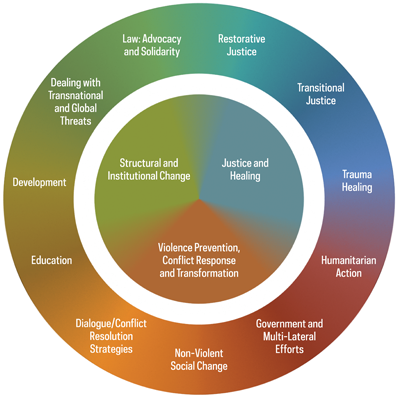
Peacebuilding is the development of constructive personal, group, and political relationships across ethnic, religious, class, national, and racial boundaries. It aims to resolve injustice in nonviolent ways and to transform the structural conditions that generate deadly conflict. Peacebuilding can include conflict prevention; conflict management; conflict resolution and transformation, and post-conflict reconciliation.
Peacebuilding becomes strategic when it works over the long run and at all levels of society to establish and sustain relationships among people locally and globally. Strategic peacebuilding connects people and groups “on the ground” (community and religious groups, grassroots organizations, etc.) with policymakers and powerbrokers (governments, the United Nations, corporations, banks, etc.) It aims not only to resolve conflicts, but to build societies, institutions, policies, and relationships that are better able to sustain peace and justice.
Strategic peacebuilders address issues of human rights, economic prosperity, and environmental sustainability as well as violence. Research on strategic peacebuilding »
Strategic peacebuilding stretches across generations. While it engages immediate crises, strategic peacebuilding recognizes that peacemaking is a long-term vocation that requires the building of cross-group networks and alliances that will survive intermittent conflicts and create a platform for sustainable human development and security.
A printable pdf version is available here »
Explore alumni profiles and potential careers in peacebuilding »
Academic Work and Publications
The Kroc Institute, along with Oxford University Press, has developed a multi-volume book series on strategic peacebuilding: The Oxford Studies of Strategic Peacebuilding. The series is edited by Scott Appleby, John Paul Lederach, and Daniel Philpott.
Books in the series include:
- When Political Transitions Work: Reconciliation as Interdependence (2020), by Fanie du Toit
- The Peace Continuum (2018), by Patrick Regan, Christian Davenport, and Erik Melander.
- Understanding Quality Peace (2018), edited by Peter Wallensteen and Madhav Joshi
- Quality Peace: Peacebuilding, Victory, & World Order (2015), by Peter Wallensteen
- Restorative Justice, Reconciliation, and Peacebuilding (2014), by Jennifer J. Llewellyn and Daniel Philpott
- Counting Civilian Casualties: An Introduction to Recording and Estimating Nonmilitary Deaths in Conflict (2013), by Taylor B. Seybolt, Jay D. Aronson, and Baruch Fischhoff
- Just and Unjust Peace: An Ethic of Political Reconciliation (2012), by Daniel Philpott
- Unionists, Loyalists, and Conflict Transformation in Northern Ireland (2011), by Lee A. Smithey
- Strategies of Peace (2010), by Daniel Philpott and Gerard Powers
As part of the Kroc Institute's 2024-2029 Strategic Plan, the writing, editing and publication of a new, state-of-the-art volume is underway, designed to revise and update the Institute's field-defining book, Strategies of Peace: Transforming Conflict in a Violent World (Oxford University Press, 2010).