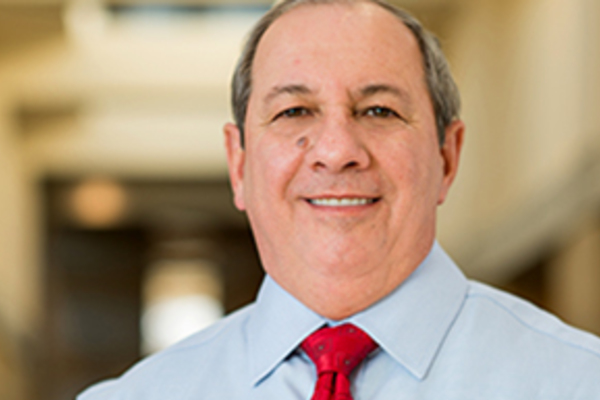
George A. Lopez
Rev. Theodore M. Hesburgh, C.S.C., Professor Emeritus of Peace Studies
107 Hesburgh Center for International Studies
Notre Dame, IN 46556
Phone: (574) 631-7498
Fax: (574) 631-6973
lopez.1@nd.edu
Areas of expertise: Economic sanctions; peacebuilding; human rights; United Nations; North Korea; peace studies program development
George A. Lopez is the Rev. Theodore M. Hesburgh, C.S.C., Professor Emeritus of Peace Studies at the Kroc Institute for International Peace Studies, where he was a founding faculty member. He is a leading expert on economic sanctions, peacebuilding, and various peace-related issues. During over 36 years of affiliation with the Kroc Institute, Lopez has engaged in a diverse set of policy and public roles. He served as interim executive director of the Bulletin of the Atomic Scientists in 1997 and chaired its Board of Directors (1998-2003), presiding over changing the hands of the Doomsday Clock in 2002. As a senior research associate at the Carnegie Council on Ethics and International Affairs in New York City from 2001-2002, he assisted with the Council’s post-9/11 public programming throughout the U.S.
Lopez held a Senior Jennings Randolph Fellowship at USIP from 2009-10. From 2013-15, he was the Vice President of the Academy for International Conflict Management and Peacebuilding at the United States Institute of Peace (USIP) in Washington, D.C. In fall 2019, he was named as one of the inaugural non-residential fellows of the Quincy Institute for Responsible Statecraft.
Since 1992, Lopez has advised the United Nations, various international agencies, and governments on economic sanctions issues, ranging from assessing their humanitarian impact to the design of targeted financial sanctions. He has written more than 40 articles and book chapters and authored or edited six books (often with Kroc Institute faculty member David Cortright) on sanctions. Lopez and Cortright’s research detailing the unlikely presence of weapons of mass destruction in Iraq was published before the 2003 Iraq War as “Disarming Iraq” in Arms Control Today and after the war as “Containing Iraq: the Sanctions Worked” in Foreign Affairs. He is a frequent media commentator regarding sanctions issues, writing often for The Hill and Responsible Statecraft.
Lopez has a deep commitment to nurturing the development of high-quality peace studies and peacebuilding education at the collegiate level. He is founding director of the Kroc Institute’s annual Summer Institute on Teaching Peace in the 21st Century. This program has assisted the development of peace research and studies programs in more than 100 higher education institutions across five continents. While at USIP, Lopez led the creation of the Global Campus online peacebuilding education platform. Most recently he has accompanied the development of university-level peacebuilding programs in Poland, Colombia, and Ecuador, the latter as a Fulbright Senior Specialist.
Recent Work
- Book: Millar, Alistair, George A. Lopez, David Cortright, and Linda Gerber-Stellingwerf. 2020. “From Crisis to Opportunity: A Policy Playbook on Nonproliferation Sanctions.” Keough School of Global Affairs. doi:10.7274/r0-zmap-7787.
- Book foreward: Lopez, George. 2020. "From Paradigm Dominance to Paradigm Hybridity: Scholarship’s Relevance to Peacebuilding." In Peacebuilding Paradigms: The Impact of Theoretical Diversity on Implementing Sustainable Peace, edited by Henry F. Carey. Cambridge University Press, 2020. Cambridge: Cambridge University Press: doi:10.1017/9781108652162
Access more resources, including Lopez's latest publications and scholarly activities.