<?xml version="1.0" encoding="UTF-8"?>
<?xml-stylesheet type="text/xsl" href="/stylesheets/feed.atom.xml" media="screen"?>
<feed xml:lang="en-US" xmlns="http://www.w3.org/2005/Atom">
  <id>tag:kroc.nd.edu,2005:/news-events/news</id>
  <link rel="alternate" type="text/html" href="https://kroc.nd.edu"/>
  <link rel="self" type="application/atom+xml" href="https://kroc.nd.edu/news-events/news.atom"/>
  <id>tag:kroc.nd.edu,2005:/latest</id>
  <title>Kroc Institute for International Peace Studies | News</title>
  <updated>2026-10-09T07:48:00-04:00</updated>
  <link rel="alternate" type="text/html" href="https://kroc.nd.edu/"/>
  <link rel="self" type="application/atom+xml" href="https://kroc.nd.edu//news-events/news.atom"/>
  <subtitle>Notre Dame's Kroc Institute is a leading center for the study of violent conflict and strategies for peace. Offers PhD, MA, BA degrees in peace studies.</subtitle>
  <entry>
    <id>tag:kroc.nd.edu,2005:News/186146</id>
    <published>2026-10-09T07:48:00-04:00</published>
    <updated>2026-10-09T07:48:33-04:00</updated>
    <link rel="alternate" type="text/html" href="https://kroc.nd.edu/news-events/news/in-support-of-international-law-2026-nobel-peace-prize-awarded-to-navanethem-pillay/"/>
    <title>In support of international law: 2026 Nobel Peace Prize awarded to Navanethem Pillay</title>
    <summary type="text">
      <![CDATA[The 2026 Nobel Peace Prize has been awarded to Navanethem Pillay from South Africa. Peter Wallensteen is the…]]>
    </summary>
    <content type="html">
      <![CDATA[<p><em>The <strong><a href="https://www.nobelprize.org/prizes/peace/2026/press-release/">2026 Nobel Peace Prize</a> </strong>has been awarded to <strong>Navanethem Pillay</strong> from South Africa. </em><em><a href="https://kroc.nd.edu/faculty-and-staff/peter-wallensteen/"><strong>Peter Wallensteen</strong></a> is the Richard G. Starmann, Sr. Research Professor Emeritus of Peace Studies at the Kroc Institute for International Peace Studies, part of the Keough School of Global Affairs, and Professor Emeritus with the Department of Peace and Conflict Research at Sweden’s Uppsala University. He also serves on the Kroc Institute's advisory board. Wallensteen offers comments on this year's award below:</em></p>
<p>The South African judge <strong>Navanethem (Navi) Pillay</strong> (b. 1941, JD Harvard) has been awarded the Nobel Peace Prize for 2026 – for her personal commitment to ”universal legal principles and her firm moral compass” that have been ”constants in a long career,” according to the Norwegian Nobel Committee, which hands out the Nobel Peace Prize.</p>
<p>Pillay was the first woman in her home province Natal, South Africa to open a law firm, and she was involved in defending opponents to the apartheid regime (including protection for those imprisoned on Robben Island). In 1998 she was appointed as a judge to the International Criminal Tribunal for Rwanda, where she convinced the tribunal to regard rape as a form of genocide. In 2003 Pillay became a judge in the International Criminal Court, followed by being appointed the United Nations High Commissioner for Human Rights.</p>
<p>This prize definitely makes a strong statement by the Nobel Committee in favor of international law, and the importance of prosecuting war crimes. Pillay stresses the necessity of using law to eliminate discrimination, control warfare and ultimately abolish war. Thus, this prize corresponds to the Alfed Nobel’s will to promote fraternity among nations. In Pillay’s case this is done by regulating relations among states and citizens through agreed norms and rules in our global society. It also means a strong repudiation of the idea that “Might is Right.” This is a timely prize providing hope in difficult circumstances.</p>]]>
    </content>
    <link rel="enclosure" type="image/jpeg" href="https://kroc.nd.edu/assets/682087/wallensteen_web.jpg" title="Elderly man with white beard and hair smiles, wearing a blue blazer and light blue shirt."/>
    <author>
      <name>Peter Wallensteen</name>
    </author>
  </entry>
  <entry>
    <id>tag:kroc.nd.edu,2005:News/185895</id>
    <published>2026-09-30T12:38:00-04:00</published>
    <updated>2026-09-30T12:38:53-04:00</updated>
    <link rel="alternate" type="text/html" href="https://kroc.nd.edu/news-events/news/in-rome-notre-dame-convening-engages-womens-voices-to-help-shape-afghanistans-future/"/>
    <title>In Rome, Notre Dame convening engages women’s voices to help shape Afghanistan’s future</title>
    <summary type="text">
      <![CDATA[A recent Notre Dame convening in Rome brought together women from the Afghan diaspora. The gathering sought to elevate women’s voices as part of ongoing conversations about building a peaceful, pluralistic future for the country.]]>
    </summary>
    <content type="html">
      <![CDATA[<figure class="image image-right"><img src="https://keough.nd.edu/assets/680516/women_in_afghanistan_1200x675.jpeg" alt="Afghan women are pictured. Notre Dame's Afghanistan Program for Peace and Development is working to elevate women's voices as it seeks broad input on what a peaceful and pluralistic future for Afghanistan might look like. Photo credit: Eric Draper / The White House." width="600" height="338">
<figcaption>The Afghanistan Program for Peace and Development is working to elevate women's voices as it seeks broad input on what a peaceful and pluralistic future for Afghanistan might look like. Photo credit: Eric Draper / The White House.</figcaption>
</figure>
<p>What is the role of religion in Afghanistan? Should a future state have an official religion? How — or should — the international community engage with the Taliban, or does doing so confer legitimacy on a repressive regime?</p>
<p>These questions were at the heart of a recent convening hosted by the <a href="https://kroc.nd.edu/policy-practice/afghan-peace-and-development-research-program/">Afghanistan Program for Peace and Development</a>, part of the<a href="https://kroc.nd.edu/policy-practice/afghan-peace-and-development-research-program/"> Kroc Institute for International Peace Studies</a> at the University of Notre Dame’s <a href="https://keough.nd.edu/">Keough School of Global Affairs.</a></p>
<p>Hosted by <a href="https://rome.nd.edu/">Notre Dame Rome</a>, the gathering brought together 20 women from the Afghan diaspora to wrestle with a variety of issues and imagine a peaceful and pluralistic future. The convening, which was organized to elevate women's voices, united this diverse group around a singular task: contributing to a larger vision for a just, inclusive and peaceful Afghanistan. It is part of a larger effort by the Afghanistan Program for Peace and Development to promote ongoing dialogue in an effort to build that future.</p>
<p>“Hope was a difficult word for me to say,” one participant said, reflecting a sentiment shared by other participants amid ongoing uncertainty over Afghanistan’s future. But hope animated the conversations that unfolded over several days.</p>
<p>Discussion explored core themes that included the role of religion and the importance of inclusion. Participants grappled with how to ensure meaningful representation across ethnic, gender, socioeconomic and regional lines, and called for the inclusion of people with disabilities, LGBTQ+ people and rural communities.</p>
<p>A central question was whether religious pluralism remains viable when some conservative interpretations of Islam disenfranchise vulnerable groups, including women. Participants recognized that religion would likely be part of Afghanistan’s future governance, thus making the work of reimagining its role even more important.</p>
<p>Conversation also focused on international engagement with the Taliban. Participants expressed concern that even minimal diplomatic contact by European and regional powers risks conferring tacit approval on an oppressive regime. This was in tension with another concern: finding leverage to demand that the regime uphold basic human rights.</p>
<p>Navigating this dilemma was further complicated by the reality articulated by an attending diplomat: There is no appetite globally or domestically for armed resistance. This dynamic has led the Afghan diaspora to seek accountability without relying on it.</p>
<p>Following virtual solidarity exchanges with veteran activists from Indonesia, Gaza, Syria, Myanmar and Northern Ireland, the focus shifted from vision to action. Drawing on insights from these contexts, participants formally committed to continuing their work together as they support building a diverse coalition to help shape Afghanistan’s future.</p>
<p>The Rome gathering is part of the broader <a href="https://kroc.nd.edu/policy-practice/afghan-peace-and-development-research-program/the-afghanistan-dialogue-and-visioning-process-dvp/">Dialogue and Visioning Process</a> organized by the Afghanistan Program for Peace and Development. The process brings together multiple constituencies, including scholars, human rights experts, political leaders, economists and activists.</p>
<p>The program has tasked each cohort with drafting a vision document of shared principles for the country's future. Earlier contributions had highlighted the need to elevate women’s voices as part of the conversation.</p>
<p>“Afghan women particularly from marginalized minorities bear the weight of the crisis like no other group,” said Aref Dostyar, program director for the Afghanistan Program for Peace and Development. “That’s why we built a dedicated space for women to facilitate internal dialogues. Their conversations will ripple outward and enrich the ongoing discussions we continue to support.”</p>
<h2>Related story</h2>
<p><a href="https://keough.nd.edu/news-and-events/news/new-partnership-aims-to-support-afghan-womens-access-to-higher-education/">New partnership aims to support Afghan women’s access to higher education</a></p>
<p class="attribution">Originally published by <span class="rel-author">Rebekah Go</span> at <span class="rel-source"><a href="https://keough.nd.edu/news-and-events/news/in-rome-notre-dame-convening-engages-womens-voices-to-help-shape-afghanistans-future/">keough.nd.edu</a></span> on <span class="rel-pubdate">September 30, 2026</span>.</p>]]>
    </content>
    <link rel="enclosure" type="image/jpeg" href="https://kroc.nd.edu/assets/680729/women_in_afghanistan_1200x675.jpeg" title="Afghan women are pictured. Notre Dame's Afghanistan Program for Peace and Development is working to elevate women's voices as it seeks broad input on what a peaceful and pluralistic future for Afghanistan might look like. Photo credit: Eric Draper / The White House."/>
    <author>
      <name>Rebekah Go</name>
    </author>
  </entry>
  <entry>
    <id>tag:kroc.nd.edu,2005:News/185749</id>
    <published>2026-09-25T16:41:00-04:00</published>
    <updated>2026-09-25T16:41:32-04:00</updated>
    <link rel="alternate" type="text/html" href="https://kroc.nd.edu/news-events/news/kroc-institute-highlighted-as-part-of-special-issue-of-peace-science-digest/"/>
    <title>Kroc Institute highlighted as part of special issue of Peace Science Digest</title>
    <summary type="text">
      <![CDATA[Photo courtesy of Wikimedia Commons, Public Domain.  A special…]]>
    </summary>
    <content type="html">
      <![CDATA[<figure class="image image-right"><img src="https://kroc.nd.edu/assets/680170/conductor_web_image_200_x_200_px_300_x_300_px_300_x_200_px_300_x_300_px_7_.webp" alt="United Nations postage stamp." width="300" height="200">
<figcaption>Photo courtesy of Wikimedia Commons, Public Domain.</figcaption>
</figure>
<p>A <a href="https://warpreventioninitiative.org/peace-science-digest/the-future-of-peace/"><strong>special issue</strong></a> of <em>Peace Science Digest, </em>"The Future of Peace," was released on Sept. 21 in recognition of the United Nations <a href="https://internationaldayofpeace.org/"><strong>International Day of Peace</strong></a>, with the Kroc Institute collaborating on the publication with the War Prevention Initiative of the Jubitz Family Foundation and the Alliance for Peacebuilding.</p>
<p>The issue considers how to adapt to shifting global dynamics and disruptions, including those caused by artificial intelligence, the climate crisis, and political fragmentation. Kroc Institute Director <strong>Asher Kaufman</strong> <a href="https://t.e2ma.net/click/0epzus/k6nkq7sr/0etigbe" rel="noopener" target="_blank" data-saferedirecturl="https://www.google.com/url?q=https://t.e2ma.net/click/0epzus/k6nkq7sr/0etigbe&amp;source=gmail&amp;ust=1790379022660000&amp;usg=AOvVaw1tRmfY2-_4dgZX3jQ_Z0eo">writes in the special issue's foreword</a>: <em>"Amid these dynamics, all of us who study and work for peace have an urgent responsibility—and opportunity—to ask ourselves tough questions and reconsider our strategies."</em></p>
<p>The issue features essays from Keough School faculty having a core affiliation with the Kroc Institute: <strong><a href="https://t.e2ma.net/click/0epzus/k6nkq7sr/g7tigbe" rel="noopener" target="_blank" data-saferedirecturl="https://www.google.com/url?q=https://t.e2ma.net/click/0epzus/k6nkq7sr/g7tigbe&amp;source=gmail&amp;ust=1790379022660000&amp;usg=AOvVaw0b6B1g3ZIY8qrR3fEiY6XQ">Lisa Schirch</a></strong>, <strong><a href="https://t.e2ma.net/click/0epzus/k6nkq7sr/wzuigbe" rel="noopener" target="_blank" data-saferedirecturl="https://www.google.com/url?q=https://t.e2ma.net/click/0epzus/k6nkq7sr/wzuigbe&amp;source=gmail&amp;ust=1790379022660000&amp;usg=AOvVaw12jmxnTQx_Fyc26oQ9oVbY">Richard (Drew) Marcantanio</a></strong>, and <strong><a href="https://t.e2ma.net/click/0epzus/k6nkq7sr/csvigbe" rel="noopener" target="_blank" data-saferedirecturl="https://www.google.com/url?q=https://t.e2ma.net/click/0epzus/k6nkq7sr/csvigbe&amp;source=gmail&amp;ust=1790379022660000&amp;usg=AOvVaw2_Cv46pU0WSQqvglSb1VaL">Josefina Echavarría Álvarez</a></strong>. Keough School Visiting Professor of the Practice <strong><a href="https://t.e2ma.net/click/0epzus/k6nkq7sr/skwigbe" rel="noopener" target="_blank" data-saferedirecturl="https://www.google.com/url?q=https://t.e2ma.net/click/0epzus/k6nkq7sr/skwigbe&amp;source=gmail&amp;ust=1790379022660000&amp;usg=AOvVaw0VnwaRzG9Abzt_FS3OP52x">Peter J. Quaranto</a> </strong>co-edited the issue.</p>
<p>Access, download and read the essays online <strong><a href="https://warpreventioninitiative.org/peace-science-digest/the-future-of-peace/">here</a>.</strong></p>
<p>The International Day of Peace was <a href="http://undocs.org/A/RES/36/67">established</a> in 1981 by the United Nations General Assembly. Two decades later, in 2001, the General Assembly unanimously voted to <a href="http://undocs.org/A/RES/55/282">designate</a> the Day as a period of non-violence and cease-fire.</p>]]>
    </content>
    <link rel="enclosure" type="image/webp" href="https://kroc.nd.edu/assets/680170/conductor_web_image_200_x_200_px_300_x_300_px_300_x_200_px_300_x_300_px_7_.webp" title="United Nations postage stamp."/>
    <author>
      <name>Kate Chester</name>
    </author>
  </entry>
  <entry>
    <id>tag:kroc.nd.edu,2005:News/185616</id>
    <published>2026-09-21T15:52:00-04:00</published>
    <updated>2026-09-21T15:52:33-04:00</updated>
    <link rel="alternate" type="text/html" href="https://kroc.nd.edu/news-events/news/kroc-institute-installs-40th-anniversary-poster-exhibit/"/>
    <title>Kroc Institute installs 40th anniversary poster exhibit</title>
    <summary type="text">
      <![CDATA[Happy 40th anniversary to the Kroc Institute for International Peace Studies! In honor of its anniversary, the Kroc Institute has installed a poster exhibit along the hallways of the Hesburgh Center for International Studies. The exhibit showcases the Institute’s achievements in the areas of…]]>
    </summary>
    <content type="html">
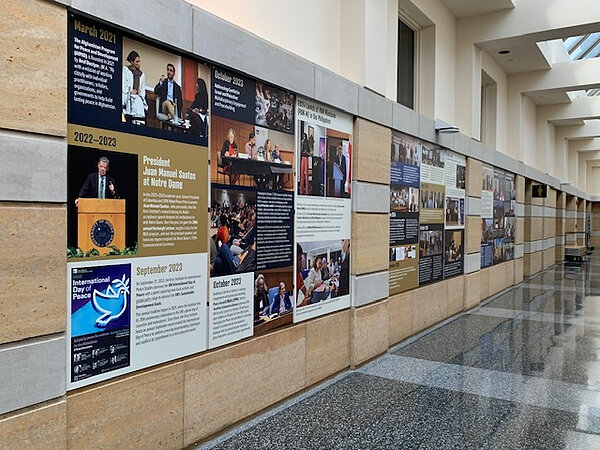
      <![CDATA[<p>Happy 40th anniversary to the Kroc Institute for International Peace Studies!</p>
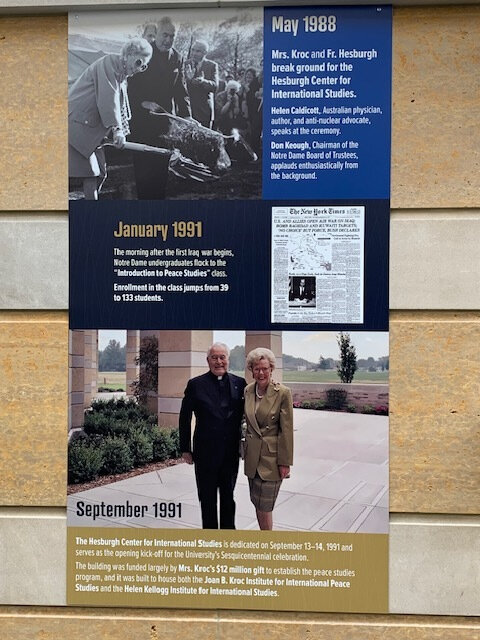
<p>In honor of its anniversary, the Kroc Institute has installed a poster exhibit along the hallways of the Hesburgh Center for International Studies. The exhibit showcases the Institute’s achievements in the areas of research, teaching and policy over four decades. The exhibit will be on display throughout the 2026-27 academic year.</p>
<p>Come check it out!</p>
<figure class="image image-right"><img src="https://kroc.nd.edu/assets/679077/img_0162.jpg" alt="Colorful posters hang along the walls of the Hesburgh Center in celebration of the Kroc Institute's 40th Anniversary." width="600" height="450">
<figcaption>Colorful posters hang along the walls of the Hesburgh Center in celebration of the Kroc Institute's 40th Anniversary.</figcaption>
</figure>
<figure class="image image-left"><img src="https://kroc.nd.edu/assets/679076/img_0159.jpg" alt="A poster of Joan B. Kroc and Father Theodore Hesburgh, C.S.C., hangs in the Hesburgh Center in celebration of the Kroc Institute's 40th anniversary." width="480" height="640">
<figcaption>Philanthropist Joan B. Kroc and Rev. Theodore M. Hesburgh, C.S.C. and former Notre Dame president, are featured as part of the Kroc Institute's 40th anniversary poster exhibit.</figcaption>
</figure>]]>
    </content>
    <link rel="enclosure" type="image/jpeg" href="https://kroc.nd.edu/assets/679075/img_0156.jpg" title="Colorful posters hang along the walls of the Hesburgh Center in celebration of the Kroc Institute's 40th Anniversary."/>
    <author>
      <name>Kate Chester</name>
    </author>
  </entry>
  <entry>
    <id>tag:kroc.nd.edu,2005:News/185315</id>
    <published>2026-09-04T18:05:00-04:00</published>
    <updated>2026-09-10T19:23:30-04:00</updated>
    <link rel="alternate" type="text/html" href="https://kroc.nd.edu/news-events/news/kroc-institute-hosts-two-visiting-research-fellows-for-the-fall-2026-semester/"/>
    <title>Kroc Institute hosts two visiting research fellows for the fall 2026 semester</title>
    <summary type="text">
      <![CDATA[Two visiting research fellows are part of the Kroc Institute for International Peace Studies for fall 2026, kicking off the Institute’s Visiting Research Fellows Program for the 2026-2027 academic year. The program brings outstanding peace studies…]]>
    </summary>
    <content type="html">
      <![CDATA[<p>Two visiting research fellows are part of the Kroc Institute for International Peace Studies for fall 2026, kicking off the Institute’s <a href="https://kroc.nd.edu/people/visiting-research-fellows/">Visiting Research Fellows Program</a> for the 2026-2027 academic year.</p>
<p>The program brings outstanding peace studies scholars to the University of Notre Dame for up to two semesters. Fellows actively integrate their research with ongoing Institute research initiatives and participate in events and lectures as part of the Institute’s learning community. Two additional fellows will join the Institute in the spring 2027 semester.</p>
<p>“The Kroc Institute prioritizes research that contributes to the interdisciplinary field of peace studies and impacts peacebuilding,” said <a href="https://kroc.nd.edu/faculty-and-staff/asher-kaufman/">Asher Kaufman</a>, John M. Regan, Jr. Director of the Kroc Institute and Professor of History and Peace Studies. “The Visiting Research Fellows Program supports this effort and ultimately opens doors to collaborative future research projects because of the professional relationships we build with fellows during their time here.”</p>
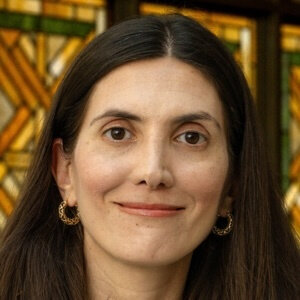
<p>Joining the Institute this fall is <strong>Anamaría Trujillo</strong> (academic year 2026-2027), who earned her Ph.D. in Sociocultural Anthropology with a designated emphasis in Feminist Theory and Research at the University of California, Davis in June 2026. For her doctoral dissertation, she performed two years of participant observation with female demobilized combatants from the Fuerzas Armadas Revolucionarias de Colombia (FARC) in the city of Medellín, Colombia. Her work was supported by the AAUW, Fulbright, and the Wenner-Gren Foundation. She also holds an M.A. in Conflict Resolution from Georgetown University.</p>
<figure class="image image-right"><img src="https://kroc.nd.edu/assets/677273/anamaria_a_different_shape.jpg" alt="Woman with long brown hair and gold earrings smiles, with stained glass in background." width="300" height="300">
<figcaption>Anamaría Trujillo</figcaption>
</figure>
<p>Trujillo’s time at the Kroc Institute will be channeled toward her book project, “Making and Un-Making Reincorporation: An Ethnography of Women Ex-combatants in Medellín.” Through her book, she wants readers to immerse themselves in female ex-combatants’ lives, and through their stories understand reincorporation processes less as a transition from war to peace and more as a process of orientation that requires pragmatic adaptations from former combatants. Through these adaptations, former FARC women contribute to building peace and transforming Colombia.</p>
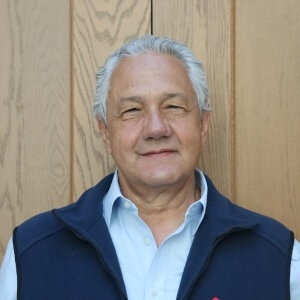
<p>Trujillo will join <strong><a href="https://franciscodiez.com.ar/">Francisco Diez</a> </strong>(spring 2026-fall 2026) who will complete his yearlong visiting research fellowship at the Kroc Institute in December 2026. Diez has used his fellowship to conduct an exhaustive review of his practical experiences in peacebuilding and political mediation in Latin America. Based on this, he will present a conceptual framework and a set of tools, strategies, and techniques useful for both scholars and practitioners in the fields of peacebuilding and mediation.</p>
<p>Diez is a longtime mediator with extensive experience working with governments, international and national nongovernmental organizations – The Carter Center, The Whitaker Peace and Development Initiative, the United Nations Development Programme (UNDP), the Organization of American States (OAS), and others – as well as with universities and civil society organizations in Latin America.</p>
<figure class="image image-left"><img src="https://kroc.nd.edu/assets/677275/yet_another_fran.jpg" alt="Man with graying hair smiles, wearing a blue vest over a light blue collared shirt." width="300" height="300">
<figcaption>Francisco Diez</figcaption>
</figure>
<p>As the representative of The Carter Center in Venezuela from 2002 to 2004, he co-mediated between former President Hugo Chávez and the opposition with the Secretary General of the OAS. Diez also served as the coordinator of the Regional Support Network for the UNDP Democratic Dialogue Program for Latin America and the Caribbean from 2004 to 2007, providing support on peacebuilding processes to the UNDP national offices. As The Carter Center representative in Latin America from 2007 to 2010, he created the Venezuela, Bolivia, and Ecuador-Colombia programs. During this time, Diez launched the Binational Dialogue Group for Ecuador and Colombia and served as the mediator between both presidents.</p>
<p>Diez was a representative for the Kroc Institute’s <a href="https://peaceaccords.nd.edu/">Peace Accords Matrix</a> program from 2014 to 2019, advising the Office of the High Commissioner for Peace in Colombia and helping to create the Barometer Project there to monitor the implementation of the country’s 2016 peace accord. Also on behalf of the Kroc Institute, he was a special advisor on the Alianza Civica movements in Nicaragua, and advised the UN resident coordinator on mediation in Ecuador during the 2018 crisis.</p>
<p>From 2020 to 2023, Diez was a full-time member of the Stand By Team of senior mediators at the UN Mediation Support Unit. Since 2023, he has been in private practice, consulting on the UNDP Perú and advising María Angela Holguín, the personal envoy of the UN Secretary General for Cyprus.</p>
<p>Diez earned his law degree from the University of Buenos Aires Law School in 1982, followed by a master’s degree in Public Administration from Harvard University, JFK School of Government, where he was awarded the John Vernon Prize for Academic Excellence. This was followed by postgraduate studies at the University of Maryland and the London School of Economics, on International Mediation.</p>
<p>For more information on the <strong>2027-28 Visiting Research Fellowship Program</strong>, click <a href="https://kroc.nd.edu/research/grants-and-fellowships/apply-for-visiting-research-fellowships/">here.</a></p>]]>
    </content>
    <link rel="enclosure" type="image/jpeg" href="https://kroc.nd.edu/assets/677278/anamaria_and_fran.jpg" title="Portrait of woman with dark hair and man with gray hair."/>
    <author>
      <name>Kate Chester</name>
    </author>
  </entry>
  <entry>
    <id>tag:kroc.nd.edu,2005:News/185314</id>
    <published>2026-09-04T14:29:00-04:00</published>
    <updated>2026-09-04T14:29:39-04:00</updated>
    <link rel="alternate" type="text/html" href="https://kroc.nd.edu/news-events/news/keough-school-welcomes-five-new-faculty-and-visiting-professors-of-the-practice/"/>
    <title>Keough School welcomes five new faculty and Visiting Professors of the Practice</title>
    <summary type="text">
      <![CDATA[As the 2026-27 academic year begins, the Keough School of Global Affairs is welcoming five new faculty who bring extensive expertise in politics and international relations, modern Irish and Ukrainian studies, national security, sustainability, entrepreneurship and more. …]]>
    </summary>
    <content type="html">
      <![CDATA[<p>As the 2026-27 academic year begins, the Keough School of Global Affairs is welcoming five new faculty who bring extensive expertise in politics and international relations, modern Irish and Ukrainian studies, national security, sustainability, entrepreneurship and more.</p>
<figure class="image image-right"><img src="https://keough.nd.edu/assets/675217/web_new_faculty_photo_resized_2026.jpg" alt="Smiling man in dark suit, woman in black blazer, and priest in clerical collar before Keough School of Global Affairs sign." width="600" height="338">
<figcaption>Left to right: Rory Finnin, Emma Murphy, Fr. James Lies. Photo by Daniel Hilles.</figcaption>
</figure>
<p>“The work of our newest colleagues — and the critical questions they address — is more vital than ever,” said Mary Gallagher, the Marilyn Keough Dean of the Keough School. “From the study of moral psychology and transitional justice to the imperatives of sustainable enterprise and international law, these experts embody the Keough School’s commitment to connecting rigorous scholarship and real-world impact. They bring diverse perspectives that will not only advance our research but will also challenge our students to think critically and creatively about how to apply their own knowledge, values and skills to the most pressing challenges of our time.”</p>
<p>New faculty include:</p>
<p><a href="https://keough.nd.edu/about/faculty-staff-directory/rory-finnin/">Rory Finnin<br></a><em>Notre Dame Collegiate Mission Chair in Ukrainian Studies<br>Director, Nanovic Institute for European Studies’ Ukrainian Studies Hub</em></p>
<p>Finnin was most recently a visiting professor of Ukrainian studies in the Keough School's<a href="https://nanovic.nd.edu/"> Nanovic Institute for European Studies. </a>Prior to coming to Notre Dame, he was professor of Ukrainian studies at the University of Cambridge, where he established the Cambridge Ukrainian Studies program in 2008.</p>
<p>Finnin has curated and organized more than 40 exhibitions and cultural events, advancing public understanding of Ukraine’s language, history and society in the U.K. and beyond. His research focuses on the interplay between culture and identity in Ukraine, with particular attention to Crimea and Crimean Tatar literature, and his broader interests include nationalism studies, solidarity studies and cultural memory in the Black Sea region. He holds a Ph.D. in Slavic languages and comparative literature from Columbia University. He is also a returned Peace Corps volunteer who served in Ukraine from 1995 to 1997. He is also a core-affiliated faculty member of the Nanovic Institute.</p>
<p><a href="https://keough.nd.edu/about/faculty-staff-directory/fr-jim-lies/">Rev. James Lies, C.S.C.</a><br><em>Teaching Professor</em></p>
<p>Fr. Lies, C.S.C., joins the Keough School faculty after serving as senior advisor for faculty fellow affairs and partnerships at the Keough School’s Nanovic Institute for European Studies. A priest of the Congregation of Holy Cross and a developmental and moral psychologist, Lies teaches and writes about the human dimensions of diplomacy, leadership, conflict, moral judgment and ethical decision-making. His teaching connects psychological theory and research with the practical and ethical challenges of global affairs, examining how identity, culture and perception shape decision-making, conflict and leadership.</p>
<p>Lies holds a doctorate in developmental psychology from the University of Minnesota, a Master of Divinity from the Jesuit School of Theology at Berkeley and a master’s degree in counseling psychology from the University of Notre Dame. He is also a core-affiliated faculty member of the Nanovic Institute.</p>
<p><a href="https://keough.nd.edu/about/faculty-staff-directory/emma-murphy/">Emma Murphy<br></a><em>Assistant Professor of Modern Ireland and Peace Studies</em></p>
<p>Murphy most recently held a postdoctoral position with the <a href="https://irishstudies.nd.edu/initiatives/clingen-family-center-for-the-study-of-modern-ireland/">Clingen Family Center for the Study of Modern Ireland</a> in the Keough School's <a href="https://irishstudies.nd.edu/">Keough-Naughton Institute for Irish Studies</a> and the <a href="https://peaceaccords.nd.edu/">Peace Accords Matrix</a> at the school's <a href="https://kroc.nd.edu/">Kroc Institute for International Peace Studies.</a> As part of this work she supported the <a href="https://legacyproject.nd.edu/">Legacy Project,</a> which preserves and engages the digital archive of the Colombian Truth Commission, and explored the lessons the Colombian peace process holds for Ireland. More broadly, Murphy’s research focuses on transitional justice; the politics of divided societies; identity in post-conflict societies; Irish politics and feminist and postmodern political theory. She holds a doctorate in politics and international relations from University College Dublin, where she was an Irish Research Council Laureate Award-affiliated fellow. She is also a core-affiliated faculty member of the Keough-Naughton Institute.</p>
<p><a href="https://keough.nd.edu/about/faculty-staff-directory/thomas-reynolds/">Tom Reynolds<br></a><em>Adjunct Professor of the Practice</em></p>
<p>Reynolds teaches courses that prepare students to examine how organizations integrate sustainability into business strategy, operations and global supply chains. He also supports the McKenna Center's <a href="https://mckennacenter.nd.edu/global-programs/urban-poverty-and-business-initiative/">Urban Poverty and Business Initiative</a>, particularly the <a href="https://mckennacenter.nd.edu/global-programs/south-bend-entrepreneurship-and-adversity-program-sbeap/">South Bend Entrepreneurship and Adversity Program</a>, where he works with students and entrepreneurs to foster entrepreneurship and expand economic opportunity. Reynolds’ professional experience spans global supply chain management, manufacturing and operations, executive consulting and organizational transformation. He came to Notre Dame through the <a href="https://ili.nd.edu/">Inspired Leadership Initiative</a> following senior leadership roles in global consulting and industry. He holds a B.S. in mechanical engineering from Cornell University and a master of business administration in finance and international business from New York University. He is also a core-affiliated faculty member of the McKenna Center.</p>
<p>Lia Brazil<br><em>Assistant Professor of Modern Ireland</em></p>
<p>Brazil will join the Keough School in January 2027 from the University of Manchester’s Humanitarian and Conflict Response Institute where she is a Leverhulme Trust research fellow. She was previously a National Endowment for the Humanities Visiting Fellow at the Keough Naughton Institute and a postdoctoral research fellow at Nuffield College, University of Oxford. She received her doctorate in history from the European University Institute, Florence. Brazil’s research centres on the history of humanitarianism, international law and human rights. She is interested in how history has informed the challenges facing NGOs today, the role of individuals under international law, and comparative and global perspectives on modern Ireland. At the Keough School she will begin a new project on human rights and modern Ireland.</p>
<p><a href="https://keough.nd.edu/about/faculty-staff-directory/frank-macchiarola/">Frank Macchiarola</a>, visiting professor of practice, is a senior energy policy and government affairs leader specializing in clean energy and energy policy. He is the chief advocacy officer of American Clean Power, where he leads government affairs and political engagement at the federal and state levels. He previously held senior leadership roles at the American Petroleum Institute and America’s Natural Gas Alliance and served as staff director of the U.S. Senate committees on Energy and Natural Resources and Health, Education, Labor and Pensions.</p>
<p><a href="https://keough.nd.edu/about/faculty-staff-directory/daniele-nyirandutiye/">Daniele Nyirandutiye</a>, visiting professor of practice, is a global strategist and senior policy practitioner specializing in U.S. foreign policy, development finance, investment and Africa. She has served at the White House National Security Council and as a U.S. diplomat with USAID, including as USAID mission director in Uganda. She brings experience working across government, the private sector and civil society to advance development, governance and inclusive economic growth in frontier markets.</p>
<p><a href="https://keough.nd.edu/about/faculty-staff-directory/david-shullman/">David Shullman</a>, visiting professor of practice, is a national security and China policy expert with extensive experience in U.S. intelligence, foreign policy and strategic analysis. He recently served as the national intelligence officer for China on the National Intelligence Council, where he was the principal advisor on China to senior U.S. policymakers. He previously served in senior roles at the Atlantic Council, the International Republican Institute and the Central Intelligence Agency.</p>
<p>Macchiarola, Nyirandutiye and Shullman are joining current visiting professors of the practice <a href="https://keough.nd.edu/about/faculty-staff-directory/amy-mcauliffe/">Amy McAuliffe</a> and <a href="https://keough.nd.edu/about/faculty-staff-directory/peter-quaranto/">Peter Quaranto</a>.</p>
<p class="attribution">Originally published by <span class="rel-author">April Toler</span> at <span class="rel-source"><a href="https://keough.nd.edu/news-and-events/news/keough-school-welcomes-five-new-faculty-and-visiting-professors-of-the-practice/">keough.nd.edu</a></span> on <span class="rel-pubdate">August 25, 2026</span>.</p>]]>
    </content>
    <link rel="enclosure" type="image/jpeg" href="https://kroc.nd.edu/assets/677228/web_new_faculty_photo_resized_2026.jpg" title="Smiling man in dark suit, woman in black blazer, and priest in clerical collar before Keough School of Global Affairs sign."/>
    <author>
      <name>April Toler</name>
    </author>
  </entry>
  <entry>
    <id>tag:kroc.nd.edu,2005:News/185224</id>
    <published>2026-09-01T14:07:00-04:00</published>
    <updated>2026-09-01T14:08:33-04:00</updated>
    <link rel="alternate" type="text/html" href="https://kroc.nd.edu/news-events/news/latin-patriarchate-of-jerusalem-to-launch-academic-forum-in-partnership-with-notre-dame/"/>
    <title>Latin Patriarchate of Jerusalem to launch academic forum in partnership with Notre Dame </title>
    <summary type="text">
      <![CDATA[His Beatitude Cardinal Pierbattista Pizzaballa, Latin Patriarch of Jerusalem, will formally launch “Within Your Gates: The Forum for the Universal Vocation of Jerusalem” on Sept. 7 in partnership with Notre Dame Jerusalem, the University of Notre Dame’s academic center in Jerusalem.]]>
    </summary>
    <content type="html">
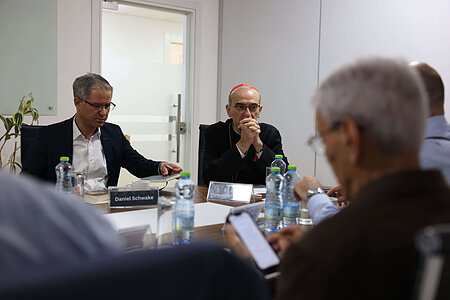
      <![CDATA[<figure class="image image-right"><img src="https://jerusalem.nd.edu/assets/675538/450x/pr7.jpg" alt="At a conference table, Daniel Schwake holds a notebook. A cardinal in a red zucchetto listens intently, hands clasped." width="450" height="300">
<figcaption>Notre Dame Jerusalem's Daniel Schwake and Cardinal Pizzaballa during a workshop in Jerusalem</figcaption>
</figure>
<p>His Beatitude Cardinal Pierbattista Pizzaballa, Latin Patriarch of Jerusalem, will formally launch “Within Your Gates: The Forum for the Universal Vocation of Jerusalem” on Sept. 7 in partnership with <a href="https://jerusalem.nd.edu/">Notre Dame Jerusalem</a>, the University of Notre Dame’s academic center in Jerusalem.</p>
<p>The forum is an interdisciplinary research initiative that will bring together scholars and practitioners from different faith traditions and disciplines to engage with Jerusalem's universal mission and its significance for those who reside within the Holy Land and beyond.</p>
<p>Led by <a href="https://jerusalem.nd.edu/about/staff/daniel-schwake/">Daniel Schwake</a>, director of Notre Dame Jerusalem, the forum grows out of more than three years of close cooperation with Cardinal Pizzaballa; <a href="https://kroc.nd.edu/faculty-and-staff/asher-kaufman/">Asher Kaufman</a>, director of the<a href="https://kroc.nd.edu/"> Kroc Institute for International Peace Studies</a>; <a href="https://nanovic.nd.edu/people/clemens-sedmak/">Clemens Sedmak</a>, director of the<a href="https://nanovic.nd.edu/"> Nanovic Institute for European Studies</a>; Notre Dame Jerusalem; and other Notre Dame colleagues.</p>
<p>“One of our most important responsibilities as Christians is to discern God’s call for us and to use our talents and gifts to serve Him and the world,” said <a href="https://www.nd.edu/about/leadership/presidents-leadership-council-and-deans/gregory-haake/">Rev. Gregory P. Haake, C.S.C.</a>, vice president for mission engagement and church affairs. “This forum creates a space for us to discern Jerusalem’s unique vocation of bringing together peoples of many faiths to build bridges and to receive God’s call to be peacemakers. I am proud that Notre Dame is working with Cardinal Pizzaballa to realize this vision of how discovering Jerusalem’s vocation can lead us to knowledge of our own.”</p>
<p>The forum will produce applied interdisciplinary research rooted in Jerusalem’s particular realities and oriented toward questions of daily life that resonate beyond the city and the surrounding region, exploring themes such as the theological significance of Jerusalem, the city's universal vocation, the language of conflict and reconciliation, and agency under conditions of constraint.</p>
<p>Cardinal Pizzaballa, who will chair the forum’s Board of Promoters, will share his vision for the initiative at the Sept. 7 launch event at the University’s Tantur campus. “The mission of earthly Jerusalem is to become the image and mirror of heavenly Jerusalem, a prophecy and promise of that universal reconciliation and peace which God desires for the whole human family,” he said. “It is to this mission that we must return.”</p>
<p>The Sept. 7 launch event will include remarks from Cardinal Pizzaballa as well as scholars and practitioners who serve on the forum’s Board of Promoters or the Advisory Committee.</p>
<p>For more information about the forum, visit <a href="http://www.withinyourgates.org">www.withinyourgates.org</a>. Questions about the launch event can be directed to <a href="mailto:jerusalem@nd.edu">jerusalem@nd.edu</a>.</p>
<p><em>Originally published by Notre Dame Jerusalem at <a href="https://jerusalem.nd.edu/news-stories/news/latin-patriarchate-of-jerusalem-to-launch-academic-forum-in-partnership-with-notre-dame/">jerusalem.nd.edu</a> on Sept. 1.</em></p>
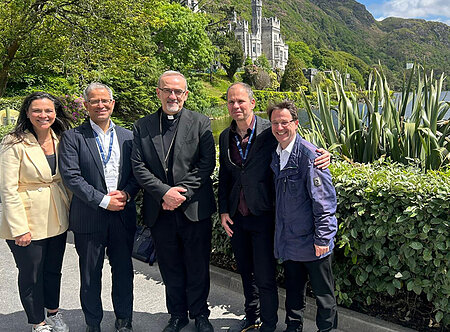
<figure class="image image-left"><img src="https://jerusalem.nd.edu/assets/675767/450x/pr5_2_.jpg" alt="Five smiling individuals, including a man in black clerical attire, stand by Kylemore Abbey, a lake, and green hills.">
<figcaption>Cardinal Pizzaballa at Kylemore Abbey with Notre Dame Kylemore Director Lisa Caulfield, Daniel Schwake, Gabriel Schwake (Vrije Universiteit Amsterdam) and Clemens Sedmak</figcaption>
</figure>
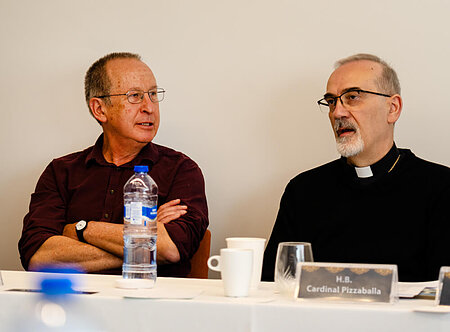
<figure class="image image-left"><img src="https://jerusalem.nd.edu/assets/675535/450x/pr2.jpg" alt="Cardinal Pizzaballa, in black clerical attire, speaks with a man in a burgundy shirt with crossed arms at a white table.">
<figcaption>Asher Kaufman sits alongside Cardinal Pizzaballa during a workshop in Cyprus.</figcaption>
</figure>
<p class="attribution">Originally published by <span class="rel-author">Notre Dame Jerusalem</span> at <span class="rel-source"><a href="https://news.nd.edu/news/latin-patriarchate-of-jerusalem-to-launch-academic-forum-in-partnership-with-notre-dame/">jerusalem.nd.edu</a></span> on <span class="rel-pubdate">September 01, 2026</span>.</p>]]>
    </content>
    <link rel="enclosure" type="image/jpeg" href="https://kroc.nd.edu/assets/676225/pr5_2_.jpg" title="Five smiling people, including a woman in cream and a cleric, stand before Kylemore Abbey, a lake, and green hills."/>
    <author>
      <name>Notre Dame Jerusalem</name>
    </author>
  </entry>
  <entry>
    <id>tag:kroc.nd.edu,2005:News/185141</id>
    <published>2026-08-28T16:11:00-04:00</published>
    <updated>2026-08-28T16:11:40-04:00</updated>
    <link rel="alternate" type="text/html" href="https://kroc.nd.edu/news-events/news/keough-school-welcomes-new-students-to-campus/"/>
    <title>Keough School welcomes new students to campus</title>
    <summary type="text">
      <![CDATA[This fall, the Keough School of Global Affairs welcomes a diverse group of undergraduate, master’s and doctoral students to campus — young leaders who are dedicated to working on global policy issues that impact human dignity and flourishing worldwide.]]>
    </summary>
    <content type="html">
      <![CDATA[<figure class="image image-right"><img src="https://keough.nd.edu/assets/674989/fullsize/mga_group_photo_feature.jpg" alt="Master of global affairs students at Notre Dame's Keough School of Global Affairs are pictured along with Mary Gallagher, the Marilyn Keough Dean of the school." width="2400" height="1350">
<figcaption>Master of global affairs students at Notre Dame's Keough School of Global Affairs are pictured along with Mary Gallagher, the Marilyn Keough Dean of the school.</figcaption>
</figure>
<p>This fall, the Keough School of Global Affairs welcomes a diverse group of undergraduate, master’s and doctoral students to campus — young leaders who are dedicated to working on global policy issues that impact human dignity and flourishing worldwide. More than 120 students, including over 70 undergraduates and over 50 graduate students, are joining the school.</p>
<p>“In a world confronting profound challenges — from climate change and conflict to threats to human rights and democracy — our students bring vital courage, expertise and vision to the Notre Dame community,” said <a href="https://keough.nd.edu/about/faculty-staff-directory/mary-gallagher/">Mary Gallagher</a>, the Marilyn Keough Dean of the Keough School. “Their lived experiences and commitment to the common good are sure to inspire all of us to think bigger and act with purpose.”</p>
<h2>Undergraduate major</h2>
<p>Some 71 undergraduate students, including 58 first-year students and 13 transfer students, will join the Keough School as <a href="https://keough.nd.edu/academics/undergraduate-programs/global-affairs-major/">global affairs majors</a> this fall.</p>
<p>The cohort includes 16 students who attended high school outside the United States. This year, four students will be part of the University’s Glynn Family Honors Program.</p>
<h2>Master of Global Affairs program</h2>
<p>The Master of Global Affairs program welcomes 43 new students, including 15 U.S. citizens and 28 international students from 16 countries: Argentina, Bangladesh, Colombia, Ecuador, Georgia, Ghana, India, Indonesia, Kenya, Lebanon, Mexico, Nepal, Pakistan, the Philippines, Portugal and Rwanda.</p>
<p>Two students were awarded the Dean’s Fellowship by the University’s Graduate School, and one student has been awarded a Truman Scholarship, an award given to U.S. students who show exceptional leadership and plan to pursue careers in public service.</p>
<p>By major, the class includes:</p>
<ul>
<li>Governance and Policy: 14 students</li>
<li>International Peace Studies: 15 students</li>
<li>Sustainable Development: 14 students</li>
</ul>
<p>This year’s students come to the Keough School from a variety of professional backgrounds. Seven are returned Peace Corps volunteers, having served in Colombia, Fiji, Jamaica, Namibia, Peru, the Philippines and Tonga. Two are former AmeriCorps national service members who served as literacy tutors and English-language instructors.</p>
<p>In addition, two students are Notre Dame undergraduate alumni. Three have experience with the Fulbright English Teaching Assistant Program, having served in Colombia, Spain and Uruguay. One is a fellow of the Oxfam Young Leaders Programme and another previously served as an advisor to former U.S. surgeon general Vivek Murthy.</p>
<h2>Doctoral programs</h2>
<h3><strong>Peace Studies Ph.D. programs</strong></h3>
<p>Five students are joining the school’s various <a href="https://keough.nd.edu/academics/phd-program/ph-d-in-international-peace-studies/">peace studies Ph.D. programs</a>.</p>
<ul>
<li>
<strong>Kumilachew Anteneh</strong> (Peace Studies and Anthropology) is an assistant professor of social anthropology at Bahir Dar University in Ethiopia. His research will explore youth agency in Ethiopia and how young people restore social belonging and moral order in the aftermath of conflict and displacement. <br><br>
</li>
<li>
<strong>Aref Dostyar </strong>(International Peace Studies) is the program director for the <a href="https://kroc.nd.edu/policy-practice/afghan-peace-and-development-research-program/">Afghanistan Program for Peace and Development</a> at the Keough School’s <a href="https://kroc.nd.edu/">Kroc Institute for International Peace Studies</a>. His research will focus on turning an existing peacebuilding initiative, the Afghanistan Dialogue and Visioning Process, into a generalizable and academically validated framework for dialogue in divided societies.<br><br>
</li>
<li>
<strong>Ruth Gelane</strong> (Peace Studies and Theology) previously completed a master’s program at Anabaptist Mennonite Biblical Seminary in Elkhart, Indiana. Her research will examine gendered, sexualized violence against women, particularly in the Ethiopian context, in a way that is rooted in African womanist discourse and wisdom. She is a Notre Dame Presidential Fellow.<br><br>
</li>
<li>
<strong>Sadiqa Sultan </strong>(International Peace Studies) is a development practitioner, peacebuilder, researcher and rights activist with more than 12 years of experience. Her research will focus on the ways exposure to trauma and violence shapes women's agency, empowerment and identity in violent contexts. <br><br>
</li>
<li>
<strong>Owen Wang </strong>(Peace Studies and Political Science) comes from George Washington University, where he recently completed his master’s degree. His research will use the case study of East Asian memory creation in post-World War II China, Korea and Japan to investigate the conceptual groundwork for their memorialization and historical consciousness. He is a recipient of the University’s <a href="https://graduateschool.nd.edu/funding/select-fellowships/notebaert-premier-fellowship/">Richard and Peggy Notebaert Premier Fellowship</a>.</li>
</ul>
<h3>Ph.D. in Sustainable Development</h3>
<p>Three students are joining the <a href="https://keough.nd.edu/academics/phd-program/ph-d-in-sustainable-development/">Ph.D. in Sustainable Development</a>, a STEM-designated program.</p>
<ul>
<li>
<strong>Fucong Niu</strong> will research how international political rivalries impact clean energy supply chains and green investments, focusing on how developing countries can build secure and fair climate strategies.<br><br>
</li>
<li>
<strong>Girika Sharma </strong>will study how climate impacts such as extreme heat affect low-income communities and how policies can be designed to better protect them. She is a Notre Dame Presidential Fellow.<br><br>
</li>
<li>
<strong>Tianyi Xiao</strong> will examine how forest conservation policies and farming practices in Africa can protect ecosystems while supporting the livelihoods of small-scale farmers.</li>
</ul>
<h2>Learn More: Keough School Academic Programs</h2>
<ul>
<li><a href="https://keough.nd.edu/academics/undergraduate-programs/global-affairs-major/">Global Affairs undergraduate major</a></li>
<li><a href="https://keough.nd.edu/academics/master-of-global-affairs/">Master of Global Affairs program</a></li>
<li><a href="https://keough.nd.edu/academics/phd-program/">Ph.D. programs</a></li>
</ul>
<p class="attribution">Originally published by <span class="rel-author">Josh Stowe</span> at <span class="rel-source"><a href="https://keough.nd.edu/news-and-events/news/keough-school-welcomes-new-students-to-campus/">keough.nd.edu</a></span> on <span class="rel-pubdate">August 24, 2026</span>.</p>]]>
    </content>
    <link rel="enclosure" type="image/jpeg" href="https://kroc.nd.edu/assets/675820/mga_group_photo_feature.jpg" title="Master of global affairs students at Notre Dame's Keough School of Global Affairs are pictured along with Mary Gallagher, the Marilyn Keough Dean of the school."/>
    <author>
      <name>Josh Stowe</name>
    </author>
  </entry>
  <entry>
    <id>tag:kroc.nd.edu,2005:News/185119</id>
    <published>2026-08-27T17:38:00-04:00</published>
    <updated>2026-08-27T17:38:24-04:00</updated>
    <link rel="alternate" type="text/html" href="https://kroc.nd.edu/news-events/news/my-arms-control-internship-learning-how-dialogue-and-bridge-building-facilitate-peace-policy/"/>
    <title>My arms control internship: Learning how dialogue and bridge building facilitate peace policy</title>
    <summary type="text">
      <![CDATA[Mia Clarke , a junior global affairs and peace studies major from Indianapolis, reflects on lessons learned from her summer internship with the Arms Control Association. ]]>
    </summary>
    <content type="html">
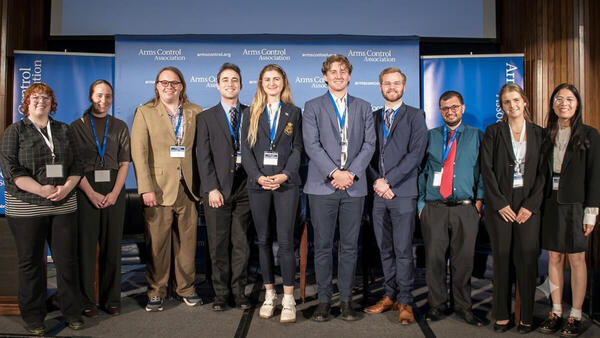
      <![CDATA[<figure class="image image-right"><img src="https://keough.nd.edu/assets/674916/group_shot.jpg" alt="Mia Clarke, second from right, interned with the Arms Control Association this past summer, an experience the underscored the importance of dialogue." width="600" height="338">
<figcaption>Mia Clarke, second from right, interned with the Arms Control Association this past summer, an experience that underscored the importance of dialogue in peacebuilding policy.</figcaption>
</figure>
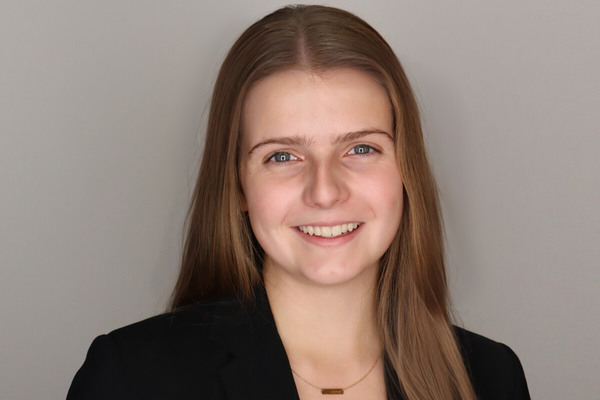
<p><em>Mia Clarke is a junior global affairs and peace studies major from Indianapolis. This summer, she interned with the Arms Control Association, building upon her previous work as a research assistant with the Catholic Peacebuilding Network. </em></p>
<p><em>The organization is housed in the Keough School's Kroc Institute for International Peace Studies and directed by Keough School faculty member Gerard Powers. </em></p>
<p>My interest in peacebuilding started in the classroom. But it was this summer’s internship with the <a href="https://www.armscontrol.org/">Arms Control Association</a> (ACA) that showed me what that policy work actually looks like on a daily basis and helped me understand the bridge building and dialogue needed to sustain that important work.</p>
<p>Throughout my coursework at Notre Dame, I have developed a strong interest in nuclear policy. During my sophomore year, I worked as a research assistant on the Catholic Peacebuilding Network’s <a href="https://cpn.nd.edu/peacebuilding-topics/nuclear-disarmament/">Project on Revitalizing Catholic Engagement on Nuclear Disarmament.</a> In that role, I engaged with students and professors from around the country and world to promote dialogue about what it looks like to realize the Catholic Church’s teaching on disarmament and just peace in an increasingly divided and conflict-driven world.</p>
<p>During one of our webinars, Kelsey Davenport, a Keough School graduate who serves as the ACA’s director of nonproliferation policy, spoke about the prospects for diplomacy, dialogue and conflict in Iran just weeks before the United States resumed strikes. I was intrigued by her commentary and how it helped me understand and interpret news about the rapidly evolving conflict with greater confidence and clarity. So when the ACA ultimately offered me an opportunity to intern for the summer, that experience was still top of mind, and I said yes.</p>
<blockquote class="pull">
<p>My summer internship with the Arms Control Association was defined by connection, and by bridging the gap between generations, organizations and audiences.</p>
</blockquote>
<p>Summer highlights included attending the ACA’s annual meeting, which convened experts from think tanks and governments, and meeting with other young people interested in nuclear policy at a conference hosted by the Carnegie Endowment. I also had the opportunity to write and to work with a professional editor for the magazine Arms Control Today. In addition, I researched and wrote for the ACA’s fact sheets and supported its policy team’s responses to developments in the Iran conflict, the U.S. relationship with Saudi Arabia and the 2027 National Defense Budget. It was a summer defined by connection, and by bridging the gap between generations, organizations and audiences.</p>
<p>These themes of connection and bridge building have stayed with me. I saw firsthand the important roles that think tanks play in dialogue around policy issues. At their very best, these institutions faciliate connections. They connect the public with experts to ease fear and misinformation; connect policy makers with experts and constituents to guide decisions; and connect members of different political parties to pursue dialogue in neutral spaces that have become increasingly hard to find and defend.</p>
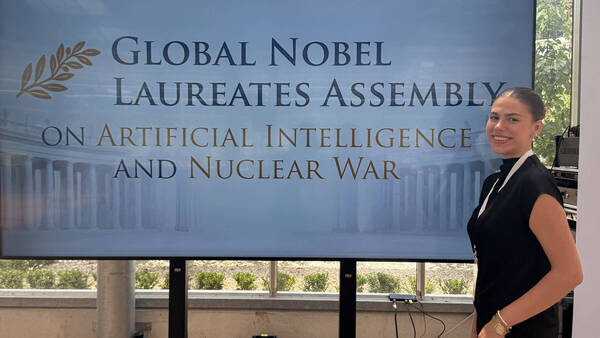
<p>One impactful example of that bridge building came toward the end of my internship, in the form of the <a href="https://globalnobelassembly.org/">Global Nobel Laureates Assembly on Artificial Intelligence and Nuclear War</a>. This three-day gathering in Rome, co-sponsored in part by the Keough School and its Kroc Institute, convened a diverse group of experts including Nobel laureates, professors and AI specialists. Among the attendees were the ACA's executive director Daryl Kimball, CPN’s coordinator, <a href="https://keough.nd.edu/about/faculty-staff-directory/gerard-powers/">Professor Gerard Powers</a> and my close friend and fellow Notre Dame student Lillian Post. I had the privilege of hearing each of their perspectives on the gathering and the related <a href="https://globalnobelassembly.org/rome-declaration">Rome Declaration</a> on AI and nuclear weapons, and of researching the declaration’s origins and the precedent that informed it.</p>
<figure class="image image-right"><img src="https://keough.nd.edu/assets/674915/headshot.jpg" alt="Mia Clarke is a junior global affairs and peace studies major from Indianapolis." width="600" height="400">
<figcaption>Mia Clarke is a junior global affairs and peace studies major from Indianapolis.</figcaption>
</figure>
<p>One question that stood out to me was how to engage younger generations in this effort. While the majority of experts agree that we need greater engagement from young people in nuclear policy, they often disagree on how to cultivate it. Many of my conversations after the declaration centered on the need to cultivate hope-based engagement with younger generations that also acknowledges and accommodates the variety of other threats young activists face today.</p>
<p>Ultimately, I used these perspectives and conversations to inform <a href="https://www.armscontrol.org/blog/2026-08-05/engaging-younger-generations-new-considerations-new-circumstances">my own post </a>on the ACA’s blog, which synthesizes my suggestions for how to adapt this call for disarmament to meet the needs of a younger generation, and how hope-based appeals can offer a more viable alternative than traditional fear-based ones.</p>
<p>In the process of outlining and drafting that piece, I worked to embody the spirit of connection and dialogue I most admired in my colleagues, an approach that I believe is increasingly valuable to facilitate problem-solving and consensus in a fractured and polarized political landscape.</p>
<p>I see my work this past summer as the first of many opportunities to bring together the perspectives of experts and practitioners as I work to make my own personal contributions to the larger work of nuclear disarmament.</p>
<h2>Read Related Post</h2>
<p>Junior global affairs and peace studies major Lillian Post, who has also worked with the Catholic Peacebuilding network, shares her experience taking a course with its coordinator, Professor Gerard Powers, which allowed her to attend a major conference on AI and nuclear weapons.</p>
<p><a class="btn" href="https://keough.nd.edu/news-and-events/news/peacebuilding-in-the-age-of-ai-and-nuclear-weapons-what-i-learned-in-rome/">Read More</a></p>
<p class="attribution">Originally published by <span class="rel-author">Mia Clarke</span> at <span class="rel-source"><a href="https://keough.nd.edu/news-and-events/news/my-arms-control-internship-learning-how-dialogue-and-bridge-building-facilitate-peace-policy/">keough.nd.edu</a></span> on <span class="rel-pubdate">August 24, 2026</span>.</p>]]>
    </content>
    <link rel="enclosure" type="image/jpeg" href="https://kroc.nd.edu/assets/675616/group_shot.jpg" title="Mia Clarke, second from right, interned with the Arms Control Association this past summer, an experience that underscored the importance of dialogue."/>
    <author>
      <name>Mia Clarke</name>
    </author>
  </entry>
  <entry>
    <id>tag:kroc.nd.edu,2005:News/185118</id>
    <published>2026-08-27T17:31:00-04:00</published>
    <updated>2026-08-27T17:32:47-04:00</updated>
    <link rel="alternate" type="text/html" href="https://kroc.nd.edu/news-events/news/peacebuilding-in-the-age-of-ai-and-nuclear-weapons-what-i-learned-in-rome/"/>
    <title>Peacebuilding in the age of AI and nuclear weapons: What I learned in Rome</title>
    <summary type="text">
      <![CDATA[Junior Lillian Post shares highlights from her involvement in Professor Gerard Powers'  summer Rome course on Catholic approaches to war and peace. The experience allowed her to attend a major conference on AI and nuclear weapons and extended her work with the Catholic Peacebuilding Network, which Powers coordinates . ]]>
    </summary>
    <content type="html">
      <![CDATA[<figure class="image image-right"><img src="https://keough.nd.edu/assets/674958/lilly_feature.jpg" alt="As a student in Professor Gerard Powers' summer Rome course on Catholic approaches to war and peace, junior Lillian Post had the opportunity to attend the Global Nobel Laureates Assembly on AI and Nuclear War." width="600" height="338">
<figcaption>Junior Lillian Post had the opportunity to attend the Global Nobel Laureates Assembly on AI and Nuclear War in Rome this summer, thanks to a course she took with Professor Gerard Powers. The course explored Catholic approaches to war and peace.</figcaption>
</figure>
<p><em>Lillian Post is a junior global affairs and peace studies major from Buffalo, New York. This summer, thanks to the Keough School, she attended a major conference on AI and nuclear weapons in Rome. Co-sponsors included the school and its Kroc Institute for International Peace Studies. <br><br>Lillian co-organized a student project on nuclear disarmament with the Catholic Peacebuilding Network, which is housed in the Keough School's Kroc Institute and directed by Keough School faculty member Gerard Powers. She was also a student in Powers' summer Rome course on Catholic approaches to war and peace. </em></p>
<p>Young people today have been spared the burden of living under the immediate threat of nuclear war, as memories of the Hiroshima and Nagasaki bombings and the Cuban Missile Crisis grow more distant with each year. As a result, many have become less engaged with the issue of nuclear weapons, relying on the false sense of security promised by nuclear deterrence. Yet from these moments of crisis emerged some of the world's most influential peace movements and scientific collaborations</p>
<p>Now, at a time when the world sits on the brink of profound nuclear risk and autonomous technologies are being rapidly integrated into lethal targeting systems, these same actors are coming together once again to form the <a href="https://globalnobelassembly.org/">Global Nobel Laureates Assembly on AI and Nuclear War</a>, calling on a new generation of peacemakers to breathe fresh life into the work they began.</p>
<p>I was fortunate to attend this group’s conference this past summer as a student co-organizer of the Catholic Peacebuilding Network’s <a href="https://cpn.nd.edu/peacebuilding-topics/nuclear-disarmament/">Project on Revitalizing Catholic Engagement on Nuclear Disarmament</a> and as a student in Professor <a href="https://keough.nd.edu/about/faculty-staff-directory/gerard-powers/">Gerard Powers’</a> summer course on Catholic approaches to war and peace. After this experience, I left Rome with the conviction that nuclear disarmament should be approached through a hopeful and cross-disciplinary lens, especially as the issue relates to the mobilization of young people.</p>
<p>The assembly (co-sponsored in part by the Keough School and its Kroc Institute) took place at Borgo Laudato Si’ in the Pontifical Villas of Castel Gandolfo from July 14-16. It convened Nobel laureates, religious leaders and representatives from arms control groups and AI companies. Participants discussed the state of nuclear policy in light of AI developments, and how to move forward. Ultimately, the assembly produced the <a href="https://globalnobelassembly.org/rome-declaration">Rome Declaration</a>, demanding strict human control over AI and the total elimination of nuclear weapons.</p>
<p>Although the conference centered on the growing risks that artificial intelligence poses to nuclear decision-making, it also returned repeatedly to a different question: Who will be responsible for confronting those risks over the coming decades? Discussions about AI quickly became discussions about the next generation, since today’s students and young professionals will inherit both the technologies reshaping warfare and the responsibility of governing them.</p>
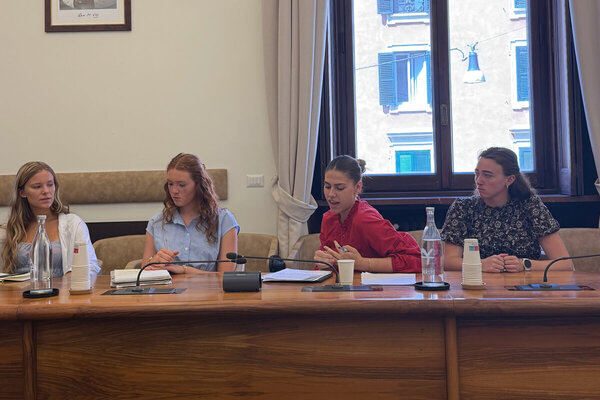
<figure class="image image-right"><img src="https://keough.nd.edu/assets/674962/lilly_2.jpg" alt="Lillian (second from right) and her classmates met with the Vatican's Dicastery for Integral Human Development as part of the course with Professor Powers." width="600" height="400">
<figcaption>Lillian (second from right) and her classmates met with the Vatican's Dicastery for Integral Human Development as part of a summer course on Catholic approaches to war and peace.</figcaption>
</figure>
<p>What struck me most was that there was no consensus on a single way to engage young people. Some participants emphasized the need to communicate the catastrophic consequences of nuclear war, while others argued that the better approach is to invite young people to the table, listen to what matters most to them, and empower them to motivate their own generation on their own terms. The debate reinforced something I had begun to recognize through my own work in nuclear disarmament: Young people are unlikely to engage with this issue simply because they are told they should. They need an entry point that makes the issue relevant to the questions they are already asking.</p>
<p>The conference’s defining characteristic was its spirit of cross-disciplinary and interreligious collaboration. Physicists, physicians, AI experts, diplomats, ethicists, peacebuilders and religious leaders all approached the issue of nuclear weapons with the shared conviction that no single discipline can address the growing risks posed by nuclear weapons and emerging technologies by itself; but each sector can contribute to the challenges challenges of AI integration and nuclear deterrence.</p>
<p>I believe the same principle applies to revitalizing youth engagement in disarmament. There is no one-size-fits-all strategy for inspiring the next generation. A student studying medicine, computer science, theology, engineering or global affairs will each arrive at this issue through different experiences and motivations. Rather than relying on fear, organizations should meet young people where they are: through the disciplines they study, the platforms they use to communicate, and the questions they are already asking about the future.</p>
<p>My own experience with the Catholic Peacebuilding Network has shown me how powerful one of these entry points can be. My interest in Catholic social teaching and peacebuilding first drew me to questions of nuclear disarmament, giving me a way to approach an issue that can otherwise feel distant or highly technical. Through the CPN’s Project on Revitalizing Catholic Engagement on Nuclear Disarmament, I have been able to connect those interests to conversations about nuclear policy, deterrence, and the future of warfare. Working alongside students and scholars from different backgrounds has shown me that my perspective is not the only way into this conversation, and that is exactly what makes interdisciplinary engagement so valuable.</p>
<blockquote class="pull">
<p>The future of nuclear disarmament will be shaped by young people who bring new disciplines, experiences and questions to the table.</p>
</blockquote>
<p>Today’s challenges are fundamentally different from the Cold War period, when many of these Nobel-winning organizations made their mark on nuclear disarmament, making youth engagement more important than ever. A new technological arms race, requires mobilization and collaboration at new interdisciplinary levels; therefore, the future of disarmament will depend on creating many pathways into the movement rather than convincing every young person with the same message.</p>
<p>Ultimately, what I took away from Rome was not a single answer for how to engage my generation, but a reminder that peacebuilding has always depended on people finding their own ways into a shared cause. The work of nuclear disarmament may have been shaped by the experiences of previous generations, but its future will be shaped by young people who bring new disciplines, experiences, and questions to the table. Our generation may not carry the lived memory of Hiroshima or the Cuban Missile Crisis, but it will inherit the responsibility of ensuring that those tragedies are never repeated.</p>
<h2>Read Related Post</h2>
<p>Junior global affairs and peace studies major Mia Clarke, who has also worked with Professor Gerard Powers and the Catholic Peacebuilding Network, shares her experience interning with the Arms Control Association this past summer. </p>
<p><a class="btn" href="https://keough.nd.edu/news-and-events/news/my-arms-control-internship-learning-how-dialogue-and-bridge-building-facilitate-peace-policy/">Read More</a></p>
<p class="attribution">Originally published by <span class="rel-author">Lillian Post</span> at <span class="rel-source"><a href="https://keough.nd.edu/news-and-events/news/peacebuilding-in-the-age-of-ai-and-nuclear-weapons-what-i-learned-in-rome/">keough.nd.edu</a></span> on <span class="rel-pubdate">August 24, 2026</span>.</p>]]>
    </content>
    <link rel="enclosure" type="image/jpeg" href="https://kroc.nd.edu/assets/675615/lilly_feature.jpg" title="As a student in Professor Gerard Powers' summer Rome course on Catholic approaches to war and peace, junior Lillian Post had the opportunity to attend the Global Nobel Laureates Assembly on AI and Nuclear War."/>
    <author>
      <name>Lillian Post</name>
    </author>
  </entry>
  <entry>
    <id>tag:kroc.nd.edu,2005:News/185117</id>
    <published>2026-08-27T17:24:00-04:00</published>
    <updated>2026-08-27T17:25:00-04:00</updated>
    <link rel="alternate" type="text/html" href="https://kroc.nd.edu/news-events/news/peace-accords-matrix-brings-implementation-expertise-to-africas-great-lakes-region/"/>
    <title>Peace Accords Matrix brings implementation expertise to Africa’s Great Lakes region</title>
    <summary type="text">
      <![CDATA[The University of Notre Dame’s Peace Accords Matrix is expanding its work to Africa’s Great Lakes region, seeking to contribute to the peace process between the Democratic Republic of Congo (DRC) and Rwanda by providing expertise on peacemaking and peacebuilding that will support the work of local stakeholders. ]]>
    </summary>
    <content type="html">
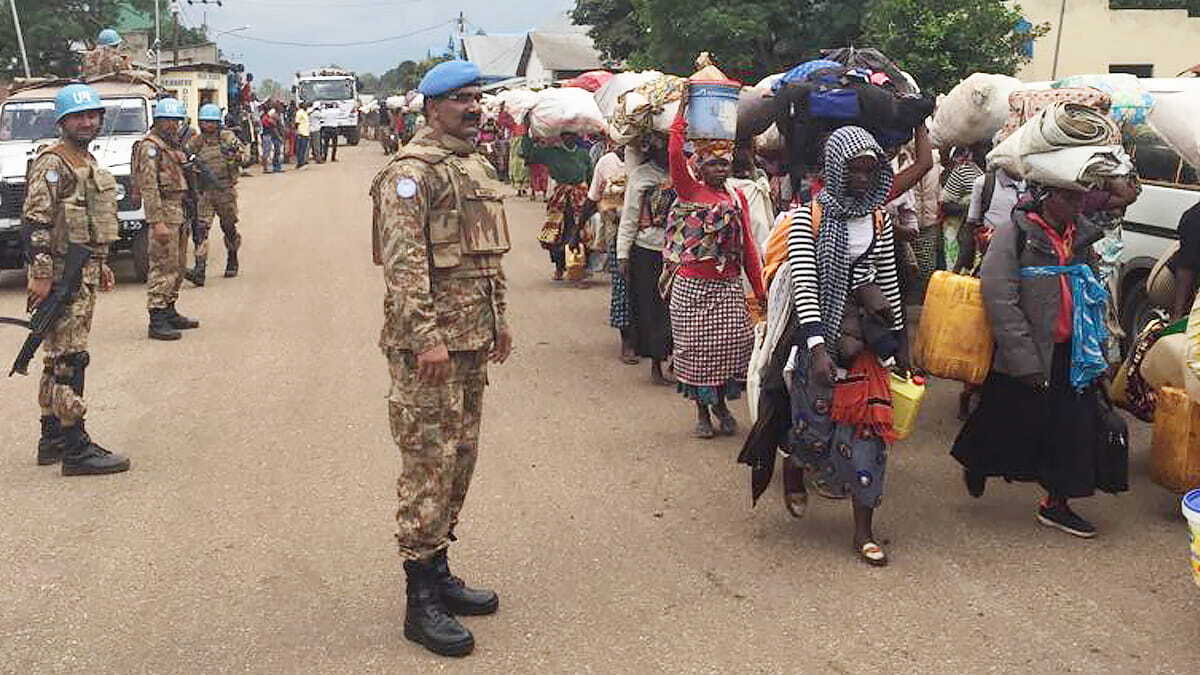
      <![CDATA[<figure class="image image-right"><img src="https://keough.nd.edu/assets/675046/fullsize/drc_feature.jpg" alt="United Nations peacekeeping troops facilitate the safe passage of people relocating from eastern DRC to Rwanda. Photo credit: MONUSCO." width="1200" height="675">
<figcaption>United Nations peacekeeping troops facilitate the safe passage of people relocating from eastern Democratic Republic of Congo (DRC) to Rwanda. <a href="https://www.flickr.com/photos/monusco/25899173187/">Photo credit: MONUSCO.</a></figcaption>
</figure>
<p>The University of Notre Dame’s <a href="https://peaceaccords.nd.edu/">Peace Accords Matrix</a> is expanding its work to Africa’s Great Lakes region, seeking to contribute to the peace process between the Democratic Republic of Congo (DRC) and Rwanda by providing expertise on peacemaking and peacebuilding that will support the work of local stakeholders.</p>
<p>The move extends the global footprint of the Peace Accords Matrix, part of the <a href="https://kroc.nd.edu/">Kroc Institute for International Peace Studies</a> at Notre Dame’s <a href="https://keough.nd.edu/">Keough School of Global Affairs</a>. The Peace Accords Matrix provides decision-makers and frontline practitioners with evidence to support the implementation of peace agreements. Its ongoing work includes monitoring implementation of agreements in Colombia and the Philippines.</p>
<p>“We know that agreements succeed or fail during the challenging implementation phase, when political leaders and peace practitioners must juggle competing demands,” said <a href="https://keough.nd.edu/about/faculty-staff-directory/josefina-echavarria-alvarez/">Josefina Echavarría Álvarez</a>, professor of the practice and director of the Peace Accords Matrix. “Strengthening this peace process will be key for the entire Great Lakes region to move beyond cycles of humanitarian crises, protect human rights and support African-led diplomacy.”</p>
<h2>Supporting the regional peace process</h2>
<figure class="image image-right"><img src="https://keough.nd.edu/assets/675051/great_lakes_region_east_africa.jpg" alt="Renewed violence since 2022 has heightened tensions across the Great Lakes region, a highly populated area in East Africa centered around a chain of lakes that includes Lake Victoria." width="600" height="400">
<figcaption>By working to strengthen the peace process between the DRC and Rwanda, Notre Dame’s Peace Accords Matrix hopes to protect human rights and support African-led diplomacy in the Great Lakes region of Africa.</figcaption>
</figure>
<p>Decades of conflict and instability in eastern DRC have displaced more than 7 million people, according to the<a href="https://www.cfr.org/global-conflict-tracker/conflict/violence-democratic-republic-congo"> Council on Foreign Relations</a>. Renewed violence since 2022 has heightened tensions across the Great Lakes region, a highly populated area in East Africa centered around a chain of lakes that includes Lake Victoria.</p>
<p>The DRC and Rwanda signed a U.S.-brokered peace agreement in June 2025, and in December the two countries formally established the <a href="https://www.state.gov/releases/office-of-the-spokesperson/2025/12/signing-of-the-washington-accords-for-peace-and-prosperity-between-the-democratic-republic-of-the-congo-and-rwanda">Washington Accords for Peace and Prosperity</a>. But implementation has proven difficult amid disputes over the sequencing and verification of commitments, and fighting has continued in eastern DRC.</p>
<p>So far, civil society groups have been chronically underengaged in the implementation process, said <a href="https://kroc.nd.edu/faculty-and-staff/carolina-serrano-idrovo/">Carolina Serrano Idrovo</a>, assistant director of research and grant operations for the Peace Accords Matrix. That risks creating a top-down process that lacks broader societal input and, ultimately, sustainability.</p>
<p>Amid those challenges, the Peace Accords Matrix is identifying civil society organizations to consult as it builds a stakeholder map of the peace and conflict landscape in the Great Lakes region.</p>
<p>“Our work is really about understanding the context as much as we can, mapping the landscape and building trust with key actors so that we can serve as a helpful resource for those at the negotiating table and those in civil society who want to participate more fully,” Serrano said.</p>
<p>The Peace Accords Matrix has engaged <a href="https://www.inclusivepeace.org/team-member/emmanuel-habuka-bombande/">Emmanuel Habuka Bombande</a>, a Ghana-based peacebuilder with decades of experience, to help coordinate this work.</p>
<p>Bombande, who co-founded the <a href="https://wanep.org/wanep/">West Africa Network for Peacebuilding</a>, has served as a senior mediation adviser to the United Nations, including with the U.N. mission in the Central African Republic, and previously worked with the Keough School’s Kroc Institute as a fellow. Along with <a href="https://kroc.nd.edu/faculty-and-staff/melinda-davis/">Melinda Davis</a>, a research associate with the Peace Accords Matrix, he is identifying key groups for the Peace Accords Matrix to consult with and planning workshops that will begin in fall 2026.</p>
<p>The resulting stakeholder map, grounded in social network analysis, will expand civil society groups’ understanding of their role in the peace process and identify opportunities to participate in it, addressing a key gap in the fragile implementation process, Serrano said.</p>
<p>“In every context in which we work, we prioritize relationships with local stakeholders,” Serrano said. “They play a critical role in shaping and sharing our analysis.”</p>
<h2>Extending a proven model</h2>
<p>The latest initiative expands the larger work of the Peace Accords Matrix, which maintains the largest collection of implementation data on intrastate peace agreements and is now active on three continents.</p>
<p>In Colombia, the Peace Accords Matrix is responsible for verification and monitoring of the implementation of the 2016 peace agreement — the first time a university-based research center has directly supported implementation of a peace accord, and the first time researchers have measured one in real time. In the Philippines, it works with Catholic Relief Services-Philippines to track progress on the 2014 Mindanao agreement.</p>
<p>In Africa’s Great Lakes region, the role of the Peace Accords Matrix will continue to evolve as the team builds relationships, Serrano said, adding that the opportunity to work on a new continent reflects the versatility of the Peace Accords Matrix and its capacity to adapt to the needs of local partners.</p>
<p>“It’s not about arriving with answers,” Serrano said. “It’s about listening to the local context so that we can be of service in a way that’s meaningful and supports a sustainable peace.”</p>
<p>The work in the Great Lakes region is supported by a grant from the <a href="https://vitol-foundation.com/">Vitol Foundation</a>, an independent, Swiss-registered foundation that invests in organizations that strengthen the resilience of the most overlooked communities.</p>
<h2>Learn more and contact</h2>
<p>To learn more about the Peace Accords Matrix, please visit <a href="https://peaceaccords.nd.edu/">its website.</a> To contact the program, please email <a href="mailto:peaceaccords@nd.edu">peaceaccords@nd.edu</a>.</p>
<p><br><br></p>
<p class="attribution">Originally published by <span class="rel-author">Josh Stowe</span> at <span class="rel-source"><a href="https://keough.nd.edu/news-and-events/news/peace-accords-matrix-brings-implementation-expertise-to-africas-great-lakes-region/">keough.nd.edu</a></span> on <span class="rel-pubdate">August 25, 2026</span>.</p>]]>
    </content>
    <link rel="enclosure" type="image/jpeg" href="https://kroc.nd.edu/assets/675614/drc_feature.jpg" title="United Nations peacekeeping troops facilitate the safe passage of people relocating from eastern DRC to Rwanda. Photo credit: MONUSCO."/>
    <author>
      <name>Josh Stowe</name>
    </author>
  </entry>
  <entry>
    <id>tag:kroc.nd.edu,2005:News/184940</id>
    <published>2026-08-19T19:16:00-04:00</published>
    <updated>2026-08-19T19:16:42-04:00</updated>
    <link rel="alternate" type="text/html" href="https://kroc.nd.edu/news-events/news/notre-dame-symposium-explores-religions-role-in-supporting-democracy/"/>
    <title>Notre Dame symposium explores religion’s role in supporting democracy </title>
    <summary type="text">
      <![CDATA[Scholars and practitioners from the University of Notre Dame and across the globe recently gathered in Rome to examine how religion can serve as a resource for democratic renewal amid authoritarian attempts to weaponize it. The convening aligns with larger work of the Notre Dame Democracy Initiative. ]]>
    </summary>
    <content type="html">
      <![CDATA[<p>Scholars and practitioners from the University of Notre Dame and across the globe recently gathered in Rome to examine how religion can serve as a resource for democratic renewal amid authoritarian attempts to weaponize it.</p>
<figure class="image image-right"><img src="https://ansari.nd.edu/assets/672943/rome_symposium_3x450jpg.jpg" alt="In a indoor panel setting featuring name cards reading" width="450" height="300">
<figcaption>Ansari Institute Book Prize winner, Erin Wilson, left, outlined how religion shapes institutions and norms in ways that policymakers often fail to see. Photo credit: Alessandro Sgarito.</figcaption>
</figure>
<p>The June 29 through July 1 symposium, “<a href="https://ansari.nd.edu/conference/religion-and-global-politics-across-disciplines-and-publics/">Religion and Global Politics across Disciplines and Publics</a>,” convened scholars, diplomats and religious leaders to discuss topics ranging from including religious voices in policy discussions to examining the ways religious institutions have both enabled and mobilized against autocratic rule.</p>
<p>The conference aligns with the <a href="https://strategicframework.nd.edu/initiatives/democracy-initiative/">Notre Dame Democracy Initiative</a> and with Notre Dame’s <a href="https://keough.nd.edu/">Keough School of Global Affairs</a>, which supports research on democracy and human rights and explores how religion connects to policy through the school’s <a href="https://ansari.nd.edu/">Ansari Institute for Global Engagement with Religion</a>. The gathering was supported by a <a href="https://strategicframework.nd.edu/initiatives/democracy-initiative/democracy-initiative-funding-opportunity/democracy-catalyst-grant-recipients/">Democracy Catalyst Grant</a> from the initiative.</p>
<p>“Religious authority is one of the few forms of trust still intact in many polarized and divided societies, and whether that trust serves the dignity and rights of all people is a central puzzle,” said <a href="https://strategicframework.nd.edu/people/joel-day/">Joel Day</a>, managing director of the Democracy Initiative. “This relationship between democracy and religion is a thematic priority of the Notre Dame Democracy Initiative for exactly this reason. This symposium underscored how the University, through the Keough School and its Ansari Institute, convenes scholars working at the forefront of these issues.”</p>
<h2>Religion still matters to politics, even when it’s ignored</h2>
<p><a href="https://ansari.nd.edu/conference/ansari-book-prize-symposium/third-symposium-religion-and-world-politics-connecting-theory-with-practice/">Erin K. Wilson</a>, recipient of the 2026 Ansari Book Prize for her book, “Religion and World Politics: Connecting Theory with Practice,” opened the symposium by challenging a common assumption in diplomacy and scholarship alike: that religion has become irrelevant to serious policymaking.</p>
<p>Wilson argued that religion continues to shape institutions and norms in ways policymakers often fail to see, precisely because they have been trained to operate in a secular idiom. The resurgence of Christian nationalism in the West, she said, is one clear sign that religion has not receded from politics. It has simply gone unaddressed. </p>
<p>Presentations throughout the symposium extended this argument across multiple contexts, including the Philippines, Kenya and Peru.</p>
<h2>Building the next generation of scholarship</h2>
<p>The symposium also showcased the Ansari Institute’s investment in emerging scholars. Its six <a href="https://ansari.nd.edu/people/global-fellows/">2025-26 Global Fellows</a> spent the academic year refining dissertations into book manuscripts with Notre Dame faculty mentors. One fellow, Jacob Katumusiime, recently signed a contract with Columbia University Press.</p>
<figure class="image image-right"><img src="https://ansari.nd.edu/assets/672944/rome_symposium_1x450jpg.jpg" alt="In a brightly lit auditorium setting filled with seated audience members, three men in the foreground wearing white shirts engage in conversation, including a smiling man in round glasses positioned centrally, a man with glasses and a beard to his left, and a bald man in profile to his right." width="450" height="300">
<figcaption>Notre Dame scholars Ebrahim Moosa, left, and Rev. Emmanuel Katongole, right, talk with Ansari Institute Global Fellow Jacob Katumusiime. Photo credit: Alessandro Sgarito.</figcaption>
</figure>
<p>On the symposium’s final day, fellows joined current and former participants in the <a href="https://ansari.nd.edu/student-opportunities/rome-summer-seminars/">Rome Summer Seminars</a>, a multiweek writing and policy-centered workshop for graduate student work on religion and global politics. The seminars were co-sponsored with John Cabot University at the European Academy of Religion’s annual conference, extending the network of scholars working at the intersection of these two academic fields of study.</p>
<p>“This convening underscores the Ansari Institute’s <a href="https://ansari.nd.edu/about/">wide-ranging work</a> to support human dignity and flourishing through research, teaching and outreach that explores how religion shapes our world,” said <a href="https://keough.nd.edu/about/faculty-staff-directory/emmanuel-katongole/">Rev. Emmanuel Katongole</a>, professor of theology and peace studies and director of the Ansari Institute. “Discussions like this are an important part of our work to connect with religious communities, faith and civic leaders, scholars and journalists as we work to inform larger conversations around religion and policy.”</p>
<p class="attribution">Originally published by <span class="rel-author">Joshua Lupo</span> at <span class="rel-source"><a href="https://ansari.nd.edu/news-events/news/notre-dame-symposium-explores-religions-role-in-supporting-democracy/">ansari.nd.edu</a></span> on <span class="rel-pubdate">August 17, 2026</span>.</p>]]>
    </content>
    <link rel="enclosure" type="image/jpeg" href="https://kroc.nd.edu/assets/674486/rome_symposium_4x1200jpg.jpg" title="In a indoor panel setting featuring name cards reading &quot;Timothy Matovina,&quot; a dark-haired woman with glasses, red lipstick, and a sleeveless dark green top speaks into a microphone held near her mouth while gesturing with her hand, turning slightly toward an older man seated beside her in a light-colored button-up shirt in front of a backdrop depicting the Colosseum in Rome. Photo credit Alessandro Sgarito."/>
    <author>
      <name>Joshua Lupo</name>
    </author>
  </entry>
  <entry>
    <id>tag:kroc.nd.edu,2005:News/184903</id>
    <published>2026-08-18T16:45:00-04:00</published>
    <updated>2026-08-18T16:45:47-04:00</updated>
    <link rel="alternate" type="text/html" href="https://kroc.nd.edu/news-events/news/engaging-the-younger-generations-new-considerations-for-new-circumstances/"/>
    <title>"Engaging the Younger Generations: New Considerations for New Circumstances"</title>
    <summary type="text">
      <![CDATA[Mia Clarke, a Notre Dame undergraduate student and co-leader of CPN's Student Disarmament Webinar series, worked a summer internship with the Arms Control Association (ACA).…]]>
    </summary>
    <content type="html">
      <![CDATA[<p>Mia Clarke, a Notre Dame undergraduate student and co-leader of CPN's <a href="https://cpn.nd.edu/events/calendar/student-disarmament-webinars/past/">Student Disarmament Webinar</a> series, worked a summer internship with the <a href="https://www.armscontrol.org/">Arms Control Association</a> (ACA). She authored a <a href="https://www.armscontrol.org/blog/2026-08-05/engaging-younger-generations-new-considerations-new-circumstances">blog post</a> for ACA focused on engaging students and youth on the renewed nuclear threat facing the world today.</p>
<p>Clarke writes: "Engaging the next generation is among the most repeated calls within the nuclear policy community. The cultural and political contexts in which the arms control and disarmament movement exists have changed dramatically over the past decade, and our methods for connecting with the younger members of the public must keep pace to remain effective. Sadly, there’s no magic formula for navigating these changes perfectly. But selecting the appropriate medium, centering hope within messaging, and building on the intersection of nuclear weapons with many other concerns can all guide efforts to engage younger audiences."</p>
<p class="attribution">Originally published by <span class="rel-author">Caesar Montevecchio</span> at <span class="rel-source"><a href="https://cpn.nd.edu/news/engaging-the-younger-generations-new-considerations-for-new-circumstances/">cpn.nd.edu</a></span> on <span class="rel-pubdate">August 11, 2026</span>.</p>]]>
    </content>
    <link rel="enclosure" type="image/jpeg" href="https://kroc.nd.edu/assets/674256/mia_clarke_conductor.jpg" title="Young woman with long brown hair and blue eyes, smiling brightly, wearing a black blazer against a light gray background."/>
    <author>
      <name>Caesar Montevecchio</name>
    </author>
  </entry>
  <entry>
    <id>tag:kroc.nd.edu,2005:News/183440</id>
    <published>2026-07-30T10:49:00-04:00</published>
    <updated>2026-07-30T10:50:46-04:00</updated>
    <link rel="alternate" type="text/html" href="https://kroc.nd.edu/news-events/news/the-wicked-problem-of-peace/"/>
    <title>The Wicked Problem of Peace </title>
    <summary type="text">
      <![CDATA[By the time the panel closed, George A. López had been in Mexico City for a little over 24 hours—just long enough to start recognizing faces in the room at Universidad Autómoma de México’s (UNAM) Centro de Investigaciones sobre América del Norte (CISAN). But López has spent a career learning that…]]>
    </summary>
    <content type="html">
      <![CDATA[<p>By the time the panel closed, George A. López had been in Mexico City for a little over 24 hours—just long enough to start recognizing faces in the room at Universidad Autómoma de México’s (UNAM) Centro de Investigaciones sobre América del Norte (CISAN). But López has spent a career learning that peace work rarely starts with a grand gesture. It starts small: one conversation, one shared room, one day, sometimes just listening.</p>
<figure class="image image-right"><img src="https://mexico.nd.edu/assets/668222/425x/unam_lopez_story_2.jpeg" alt="Five panelists, three women and two men, are seated at a dark blue table below a screen showing four virtual participants." width="600" height="400"></figure>
<p>The Notre Dame professor was in Mexico City for the first edition of a seminar meant to become permanent: "Transnationalization of the Culture of Peace in North America.” This event was organized by UNAM's Coordinación de Humanidades together with CISAN, the Institute of Social Research, the Faculty of Psychology, the National School of Social Work, the Centro de Estudios Mexicanos UNAM in Chicago, and the University of Notre Dame.</p>
<p>López participated in the panel, “University of Notre Dame: Years of Experience in Academic Peace Culture,” moderated by María Mercedes Salmon, Notre Dame Mexico’s director. Beside him, on a screen, was Erin Corcoran, executive director of Notre Dame's <a href="https://kroc.nd.edu/">Kroc Institute for International Peace Studies</a>. This logistical arrangement reflects something about the work itself: peacebuilding across a border rarely happens only in one place at one time. Sometimes it requires meeting halfway and showing up however it’s possible.</p>
<p>Corcoran opened with the institute's origin story. Kroc was founded nearly 40 years ago, inspired by the shared vision of Father Theodore Hesburgh and its principal donor, Joan Kroc, in the shadow of the Cold War and the fear of nuclear proliferation. The earliest idea was to bring students from Cold War countries to Notre Dame to study alongside Notre Dame's own students, and see whether living and learning together could do what treaties alone could not. Peace, in those years, mostly meant the absence of violence. It took decades—and, Corcoran said, the accumulated experience of some 2,200 alumni now working in more than 100 countries—for that definition to widen into something more demanding: not just the absence of violence, but the presence of justice, reconciliation, and accountability.</p>
<figure class="image image-left"><img src="https://mexico.nd.edu/assets/668224/400x/unam_lopez_story_4.jpeg" alt="Five men meet in a blue-walled room. One man speaks, gesturing; others listen and take notes at a table with laptops." width="600" height="450"></figure>
<p>López's own memory of the institute's first year carries the same lesson. In 1986, newly recruited to help build something that didn't yet exist, he ran an open workshop for any faculty member curious about the peace institute. An architecture professor came up to him afterward, delighted to have found what he called “people of the wicked problem”—his own field's term for questions with no clean solution. He explained to López that he taught students to build houses that hold on a hillside, houses that hold in sand, and houses that survive a hurricane. What nobody teaches is how to build a house that has to do all three at once. It was at that moment that López realized that peace studies was a wicked problem. The discipline dealt with injustice, violence, and militarism, all at once, and there was no clean solution. Nevertheless, this was no excuse to stop trying.</p>
<p>Peace studies, both López and Corcoran made clear, is not what it was when Kroc began. It now reaches into migration, corruption, the violence that crosses the US-Mexico border in both directions—problems too tangled to solve one discipline at a time. López offered the frame the Keough School now teaches under: integral human development, in which peace depends as much on economic and justice systems as it does on the absence of conflict. Universities, he said, tend to think in straight lines, but peace refuses that shape. It has to be built inductively, as you go, with a lot of trial and error.</p>
<p>The same issues apply close to home. What does a university owe the community just outside its gates, at a moment when violence is everywhere? Corcoran was unsentimental about it: Notre Dame doesn't sit on a hill in South Bend. Students don't need to travel abroad to see conflict or poverty—they can walk two miles down the street. López's answer was smaller still, and somehow more hopeful: tell whatever small stories of peace you have, and say them out loud. A reconciled friendship. A council that finally agreed to talk. Peace, he said, is not waiting to be found. It has to be created, one small anecdote at a time.</p>
<p>It is exactly that widened understanding of peace—built across disciplines and in every aspect of our daily life, tested against real violence—that Notre Dame brought into the room in Mexico City. And it is exactly what UNAM has been striving towards through PUCPAZ, UNAM's Programa Universitario sobre Cultura de Paz y Erradicación de las Violencias (University Program on the Culture of Peace and the Eradication of Violence).</p>
<figure class="image image-right"><img src="https://mexico.nd.edu/assets/668223/400x/unam_lopez_story_3.jpeg" alt="Maria Mercedes Salmon and George Lopez present at a CISAN panel. A Mexican flag stands nearby and online participants are on screen." width="600" height="577"></figure>
<p>The program, launched by UNAM's Coordinación de Humanidades, aims to counter the violence experienced across the country, particularly within the high school system. PUCPAZ rests on three pillars: mediation, gender perspective, and human rights. According to the director, peace is not the absence of conflict but a different way of resolving it, one where social violence is not the only option communities reach for when they disagree.</p>
<p>The Kroc Institute has spent nearly 40 years learning exactly what PUCPAZ is only beginning to discover: not just how to teach peace, but how to build an institution capable of teaching it well, semester after semester. Under López's own direction, Kroc's Summer Institute on Teaching Peace spent over a decade helping more than 100 universities across five continents go from wanting a peace studies program to actually having one. That is the collaboration this first seminar was quietly built to start.</p>
<p>María Mercedes Salmon closed the panel by thanking Corcoran and López for sharing not just their expertise but also their struggles. What had happened in that room, she said, was the start of exactly what PUCPAZ had asked for: two universities agreeing to keep teaching each other. The next exchange is planned for the end of the year. For an institution built on the conviction that peace moves forward one step at a time, the seminar had the only kind of ending that made sense. It was not a conclusion, but the first step of a much longer road the two universities will walk together.</p>
<p class="attribution">Originally published by <span class="rel-author">Norma Sofia Rivera Padilla</span> at <span class="rel-source"><a href="https://mexico.nd.edu/news-stories/news/the-wicked-problem-of-peace/">mexico.nd.edu</a></span> on <span class="rel-pubdate">July 29, 2026</span>.</p>]]>
    </content>
    <link rel="enclosure" type="image/jpeg" href="https://kroc.nd.edu/assets/668401/unam_lopez_story_1.jpeg" title="George Lopez, Anel Perez Martinez, and three others on a panel, with a Mexican flag and a speaker addressing an audience."/>
    <author>
      <name>Norma Sofia Rivera Padilla</name>
    </author>
  </entry>
  <entry>
    <id>tag:kroc.nd.edu,2005:News/183273</id>
    <published>2026-07-21T20:17:00-04:00</published>
    <updated>2026-07-21T20:17:14-04:00</updated>
    <link rel="alternate" type="text/html" href="https://kroc.nd.edu/news-events/news/mediation-theory-meets-practice-in-switzerland-in-summer/"/>
    <title>Mediation theory meets practice in Switzerland this summer</title>
    <summary type="text">
      <![CDATA[Each year in June, Laurie Nathan, director the of the Mediation Program, runs an annual Ph.D. course on international mediation, which this year was co-hosted by the Kroc Institute and a new partner,…]]>
    </summary>
    <content type="html">
      <![CDATA[<p>Each year in June, <a href="https://kroc.nd.edu/faculty-and-staff/laurie-nathan/">Laurie Nathan</a>, director the of the<a href="https://kroc.nd.edu/policy-practice/mediation-program/"> Mediation Program</a>, runs an annual Ph.D. course on international mediation, which this year was co-hosted by the Kroc Institute and a new partner, the Geneva Graduate Institute in Switzerland. "International Mediation: Theory, Cases and Skills," a five-day residential course, provides an opportunity for Ph.D. students from around the world to explore the theoretical, empirical, policy and practical dimensions of mediation in high intensity conflict.</p>
<p>Read more about this summer's mediation course <a href="https://www.graduateinstitute.ch/communications/news/theory-meets-practice-new-international-mediation-phd-course">here</a>. <em>Photo courtesy of the Geneva Graduate Institute.</em></p>]]>
    </content>
    <link rel="enclosure" type="image/jpeg" href="https://kroc.nd.edu/assets/667286/ln_summer_geneva_course.jpg" title="A diverse group of 17 people smiling and standing in an indoor conference room with a screen."/>
    <author>
      <name>Kate Chester</name>
    </author>
  </entry>
  <entry>
    <id>tag:kroc.nd.edu,2005:News/182778</id>
    <published>2026-06-29T12:39:00-04:00</published>
    <updated>2026-06-29T12:39:45-04:00</updated>
    <link rel="alternate" type="text/html" href="https://kroc.nd.edu/news-events/news/laurie-nathan-leads-june-mediation-course-for-senior-un-officials-in-switzerland/"/>
    <title>Laurie Nathan leads June mediation course for senior UN officials in Switzerland</title>
    <summary type="text">
      <![CDATA[Laurie Nathan leads the United Nations High Level Mediation…]]>
    </summary>
    <content type="html">
      <![CDATA[<figure class="image image-right"><img src="https://kroc.nd.edu/assets/664340/laurie_nathan_conductor_switzerland_2026.webp" alt='A man in a pink shirt and glasses gestures towards a whiteboard defining "Mediation" from the UN.' width="400" height="300">
<figcaption>Laurie Nathan leads the United Nations High Level Mediation Course in Switzerland.</figcaption>
</figure>
<p><a href="https://kroc.nd.edu/faculty-and-staff/laurie-nathan/">Laurie Nathan</a>, director of the <a href="https://kroc.nd.edu/policy-practice/mediation-program/">Mediation Program</a> at the Kroc Institute, part of the <a href="https://keough.nd.edu/">Keough School of Global Affairs</a>, was the lead trainer at the annual United Nations High Level Mediation Course held in Glion, Switzerland in June. Convened by the UN Mediation Support Unit in partnership with the Swiss government, the course offers senior officials from the UN and other peacemaking organizations an opportunity to deepen their knowledge and skills in mediation.</p>
<p>This year’s course enrolled 22 participants. Nathan has designed and taught the course for the past 10 years.</p>]]>
    </content>
    <link rel="enclosure" type="image/webp" href="https://kroc.nd.edu/assets/664340/laurie_nathan_conductor_switzerland_2026.webp" title="A man in a pink shirt and glasses gestures towards a whiteboard defining &quot;Mediation&quot; from the UN."/>
    <author>
      <name>Kate Chester</name>
    </author>
  </entry>
  <entry>
    <id>tag:kroc.nd.edu,2005:News/182731</id>
    <published>2026-06-26T13:30:00-04:00</published>
    <updated>2026-06-26T13:30:46-04:00</updated>
    <link rel="alternate" type="text/html" href="https://kroc.nd.edu/news-events/news/mechanisms-for-healing-in-a-broken-world-the-focus-of-the-kroc-institutes-second-annual-strategic-peacebuilding-academy/"/>
    <title>Mechanisms for healing in a broken world, the focus of the Kroc Institute’s second annual Strategic Peacebuilding Academy</title>
    <summary type="text">
      <![CDATA[The University of Notre Dame welcomed approximately 100 participants, speakers and facilitators from around the world May 26-30, here for the second annual Strategic Peacebuilding…]]>
    </summary>
    <content type="html">
      <![CDATA[<p>The University of Notre Dame welcomed approximately 100 participants, speakers and facilitators from around the world May 26-30, here for the second annual <a href="https://kroc.nd.edu/about-us/strategic-peacebuilding/kroc-institute-strategic-peacebuilding-academy/summer-2026-modes-of-healing/">Strategic Peacebuilding Academy</a> hosted by the <a href="https://kroc.nd.edu/">Kroc Institute for International Peace Studies</a>, part of the <a href="https://keough.nd.edu/">Keough School of Global Affairs</a>.</p>
<figure class="image image-right"><img src="https://kroc.nd.edu/assets/664049/4.webp" alt="A bald, older Black man in a dark suit with a focused expression speaks at a clear podium, gesturing." width="400" height="300">
<figcaption>Emmanuel Katongole</figcaption>
</figure>
<p>Practitioners, artists, scholars, writers, researchers and faith leaders were among those attending or leading sessions as part of this year’s Academy, whose theme was “Modes of Healing.” Each day of the conference offered a track that supported this year’s theme: “Grounding Our Narratives,” “Embodiment and Ritual,” “Creative Expression” and “Looking Forward.” Over four days of networking, sessions, keynote addresses and on-campus activities, participants embraced the idea of healing as a necessary, if not foundational, practice of peace.</p>
<figure class="image image-left"><img src="https://kroc.nd.edu/assets/664056/1.webp" alt="A man in a blue striped shirt and glasses smiles while seated at a table. A woman in a white head covering is behind him." width="400" height="300">
<figcaption>Kroc Institute Director Asher Kaufman</figcaption>
</figure>
<p>“‘Modes of Healing’ turned out to be a prescient theme,” said <a href="https://kroc.nd.edu/faculty-and-staff/kathryn-sawyer-vidrine/">Kathryn Sawyer Vidrine</a>, program director for the Academy, who also serves as the assistant director for doctoral studies at the Kroc Institute.</p>
<p>“Participants noted towards the end that they had come expecting to learn discrete tools and theories to use in their work, but left having had an experience of healing in many respects themselves.”</p>
<p>The conference kicked off with an evening outdoor welcome reception, followed the next morning by the opening keynote—”The One Thing Needful: Towards a Spirituality of Peacebuilding”—from <a href="https://kroc.nd.edu/faculty-and-staff/emmanuel-katongole/">Emmanuel Katongole</a>, a professor of theology and peace studies who was recently was appointed to the directorship of the Keough School’s <a href="https://ansari.nd.edu/">Ansari Institute for Global Engagement with Religion</a>.</p>
<figure class="image image-right"><img src="https://kroc.nd.edu/assets/664052/6.webp" alt="A blonde woman in a grey blazer and green top speaks into a microphone, a man in glasses smiles behind her." width="400" height="300">
<figcaption>Professor Laura Miller-Graff introduces Mike Wessells.</figcaption>
</figure>
<p>Building on Pope Francis’ 2015 landmark encyclical “Laudato sì: On the Care for our Common Home,” Katongole spoke to how genuine healing begins with attentiveness to spirituality (click <strong><a href="https://www.youtube.com/watch?v=OTvEJSsimTA">here</a> </strong>to watch his presentation). Drawing from the wisdom of global leaders representing many faith communities, with many shared values, he described how attending to the “one thing needful” is at the heart of peacebuilding, and that the act of listening is a kind of communion and way of life—with God, each other and the Earth itself.</p>
<p>Other keynote speakers were Columbia University’s <a href="https://www.publichealth.columbia.edu/profile/michael-wessells-phd">Mike Wessells</a>, who specializes in clinical, population and family health and spoke on “Psychosocial Healing and Peacebuilding in Conflict-Affected Settings: Approaches, Challenges and Priorities," and <a href="https://blueflowerarts.com/artist/layli-long-soldier/">Layli Long Soldier</a>, an Oglala Lakota writer, poet, visual artist and educator, who presented on kinship as a responsibility and art practice.</p>
<figure class="image image-left"><img src="https://kroc.nd.edu/assets/664051/7.webp" alt="Woman with dark curly hair, glasses, and a light jacket speaks into a microphone at a wooden podium, gesturing animatedly." width="400" height="300">
<figcaption>Layli Long Soldier</figcaption>
</figure>
<p>Work group activities and more than 20 panels, breakout and plenary sessions featuring a broad array of topics were offered over the four days. Among these was a session on cultural considerations in psychosocial care led by <a href="https://kroc.nd.edu/faculty-and-staff/laura-miller-graff/">Laura Miller-Graff</a> that was standing-room-only. Actress <a href="https://www.bopetersen.biz/">Bo Petersen</a> performed a one-woman show, “Pieces of Me,” an autobiographical play that exposes the emotional cost of living secretly as a mixed-race family in apartheid South Africa. Three representatives from <a href="https://homeboyindustries.org/">Homeboys Industries</a>, an organization that caters to rehabilitating those who have been incarcerated, members of gangs, homeless, and/or involved with substance abuse, spoke to their paths to recovery in a panel moderated by doctoral student <a href="https://kroc.nd.edu/ph-d/ph-d-students/joachim-chukwuebuka-ozonze/">Joachim Ozonze</a>. In another session, members of <a href="https://www.ephemeralensemble.com/rewind">REWIND Ephemeral Ensemble</a> explored how embodied theatre-making can move individuals beyond the rational and push aside obstacles to peacebuilding. The conference closed with a formal dinner and reflections on the week’s learnings and discoveries.</p>
<figure class="image image-right"><img src="https://kroc.nd.edu/assets/664055/2.webp" alt="Four panelists from Homeboy Industries sit at a table. Eduardo Aparicio Chavez, wearing black, takes notes. Two men smile." width="400" height="300">
<figcaption>Joachim Ozonze (second from right) with Homeboy Industries representatives.</figcaption>
</figure>
<p>“We sought to create an agenda that was broad in terms of healing topics addressed—and the methods to address healing as part of peacebuilding,” said <a href="https://kroc.nd.edu/faculty-and-staff/norbert-koppensteiner/">Norbert Koppensteiner,</a> director of the international peace studies major as part of the Keough School’s Master of Global Affairs (MGA) program, who led the Academy’s content planning committee.</p>
<p>“The range of topics and the themes that surfaced were vast: from healthcare, to art forms, trust building, individual and collective healing, decolonizing healing and spirituality in all its essence,” he said.</p>
<p>The Academy also attracted alumni now working in the peacebuilding field. Malalai Habibi and Jasmine (KP) Passa, both part of the 2019 inaugural MGA graduating class, attended this year’s gathering and met up with other alumni onsite thanks to the coordination of <a href="https://kroc.nd.edu/faculty-and-staff/anne-e-hayner/">Anne Hayner</a>, associate director for Alumni Relations.</p>
<p>“What stayed with me most was John Paul Lederach's framing of resilience as not just bouncing back but bouncing back to purpose,” said Habibi, a practitioner with more than a decade of experience in human and women’s rights, peace and security, advocacy and grantmaking. She currently advises the <a href="https://kroc.nd.edu/policy-practice/afghan-peace-and-development-research-program/">Afghanistan Program for Peace and Development</a>.</p>
<figure class="image image-left"><img src="https://kroc.nd.edu/assets/664054/3.webp" alt="Three participants, two holding yellow sticky notes, look down intently. A man in a blue plaid shirt smiles in the background." width="400" height="300">
<figcaption>Malalai Habibi (MGA '19, left) in the "Art and Constestation" session.</figcaption>
</figure>
<p>“He emphasized that systems of harm reproduce isolation and reactivity, and that resisting them requires imagination, creativity, and accompaniment. In my work alongside women of Afghanistan, navigating nonviolent resistance under gender apartheid, I realized I’ve been living inside these ideas without always stepping back to see the larger frame. The week gave me some of that perspective and some of the language to go with it,” she said.</p>
<p>Another learning was the importance of space for the inner life of a practitioner—not as a side conversation but as central to the work. Habibi is currently invested in an initiative that sits at the intersection of art, storytelling, human rights and peacebuilding, with women of Afghanistan as creators and leaders.</p>
<figure class="image image-right"><img src="https://kroc.nd.edu/assets/664050/8.webp" alt="A man in a checkered shirt, glasses, and beard speaks and gestures in front of a blackboard with a poll question." width="400" height="300">
<figcaption><a href="https://keough.nd.edu/about/faculty-staff-directory/peter-quaranto/">Peter Quaranto</a> (B.A. '06) led the session, "Foresight as Resilience."</figcaption>
</figure>
<p>“The Academy sharpened my thinking about what it means to hold space for imagination under prolonged authoritarianism and displacement, and it reminded me that the creative and the political are not separate tracks. I am carrying that into the work ahead,” said Habibi.</p>
<p>Passa is currently building a dance facilitation model enabling local organizations to lead on context and community needs, as she integrates healing-informed peacebuilding frameworks and Kuchipudi classical dance technique. The vision is that together, parties will co-design mythological storytelling workshops, to empower vulnerable communities.</p>
<p>“I came to the Academy hoping to brainstorm my idea of classical dance, peacebuilding, empowerment and healing, and wanting to reconnect with my peacebuilding theoretical roots,” said Passa.</p>
<p>“What made an impression on me is that healing is a broad term and intersects with many different parts of peacebuilding work. It can't be siloed but must be integrated throughout conflict work for sustainable peace to be built.”</p>
<p>Overall, the take-away feeling at the end of the gathering was one of joy.</p>
<p>“The Strategic Peacebuilding Academy is different from an academic or professional conference,” said Sawyer Vidrine, when asked to sum up the convening.</p>
<p>“You sense calm, peace, openness and gratitude. The Academy takes people from different regions, professions, and walks of life and turns them, in a matter of a few days, into a real community.”</p>
<p>Peace education—how to teach the discipline, what to teach in light of rapidly changing environments and political agendas, and more—will be the theme of the 2027 Academy, to be held again on the Notre Dame campus. Details and dates are being determined; visit the Academy <a href="https://kroc.nd.edu/about-us/strategic-peacebuilding/kroc-institute-strategic-peacebuilding-academy/">web page</a>, where updated information will be posted.</p>]]>
    </content>
    <link rel="enclosure" type="image/webp" href="https://kroc.nd.edu/assets/664053/5.webp" title="Diverse group intently examines art prints and sticky notes laid out on a table in a classroom setting, appearing engaged."/>
    <author>
      <name>Kate Chester</name>
    </author>
  </entry>
  <entry>
    <id>tag:kroc.nd.edu,2005:News/182738</id>
    <published>2026-06-25T14:03:00-04:00</published>
    <updated>2026-06-25T14:04:07-04:00</updated>
    <link rel="alternate" type="text/html" href="https://kroc.nd.edu/news-events/news/new-partnership-aims-to-support-afghan-womens-access-to-higher-education/"/>
    <title>New partnership aims to support Afghan women’s access to higher education</title>
    <summary type="text">
      <![CDATA[A new partnership between the Keough School of Global Affairs and Woman Online University in Afghanistan aims to expand educational opportunities for Afghan women and girls amid the Taliban’s sweeping restrictions. ]]>
    </summary>
    <content type="html">
      <![CDATA[<figure class="image image-right"><img src="https://keough.nd.edu/assets/664007/afghan_education.jpg" alt="A young woman in a red headscarf writes in a binder, eyes downcast in concentration. Another woman in yellow watches from the background." width="600" height="400">
<figcaption>Despite the Taliban’s sweeping restrictions on education, Afghan women and girls continue to find creative paths to learning. More than 90 percent of Afghans support their right to learn.</figcaption>
</figure>
<p>For more than two million women and girls in Afghanistan, educational opportunities have narrowed dramatically since the Taliban's return to power in 2021. Afghanistan is the only country in the world that prohibits girls from continuing beyond the sixth grade, even though more than 90 percent of Afghans support their right to learn, according to <a href="https://www.unwomen.org/en/news-stories/press-release/2025/08/four-years-after-taliban-takeover-afghans-overwhelmingly-back-girls-education">U.N. Women</a>.</p>
<p>A new partnership between the <a href="https://keough.nd.edu/">Keough School of Global Affairs</a> and <a href="https://8am.media/eng/woman-online-university-a-breath-of-hope-in-the-dark-winter-of-girls-education-in-afghanistan/">Woman Online University </a>in Afghanistan aims to expand educational opportunities for Afghan women amid the country’s ongoing restrictions. <a href="https://8am.media/eng/woman-online-university-a-breath-of-hope-in-the-dark-winter-of-girls-education-in-afghanistan/">Founded in 2022</a>, Woman Online University has served more than 20,000 students across 16 academic disciplines, offering nearly 800 classes per week as well as significant mental health resources.</p>
<p>The institutions will work together to expand educational offerings for Woman Online University students through joint courses, research initiatives, academic events and resource-sharing. They also plan to co-host conversations on the challenges and opportunities facing higher education in Afghanistan.</p>
<p>“This partnership is about sustaining educational opportunity and intellectual community in a context where access to education has been deeply constrained,” said <a href="https://keough.nd.edu/about/faculty-staff-directory/mary-gallagher/">Mary Gallagher</a>, the Marilyn Keough Dean of the Keough School. “And we see, as we have previously, how Afghan students continue to seek out learning in remarkable ways. That resilience is something that we cannot ignore and should encourage.”</p>
<p><strong>Resilience amid adversity</strong></p>
<figure class="image image-right"><img src="https://keough.nd.edu/assets/664008/afghanistan_2.jpg" alt="Participants celebrated the partnership to support women’s education in Afghanistan during a recent virtual ceremony." width="600" height="400">
<figcaption>Participants celebrated the partnership to support women’s education in Afghanistan during a recent virtual ceremony.</figcaption>
</figure>
<p>That resilience was on display at a virtual signing ceremony for the memorandum of understanding, where women like Samina, a medical student, shared how the online university had changed their lives.</p>
<p>“When I graduated from high school, I dreamed of becoming a doctor,” Samina said. “I wanted to serve people in my community. Then the doors of higher education were closed to us and I was shocked. What should I do now?”</p>
<p>Samina enrolled in Woman Online University after her father saw a social media post about it. And she is already using her education. Last year, when an earthquake in Afghanistan’s eastern Kunar province killed 800 people and injured more than 2,500, she used her hard-won skills to tend to people on the front lines.</p>
<p>“I worked alongside medical professionals, providing basic health care services,” Samina said. “At that moment, I asked myself, if I had not received this educational opportunity, would I have been able to help my people like that? Everything I am today, and every hope I have for my tomorrow, began with access to education.”</p>
<p>Raihan, a law student, said that the Taliban’s education ban was particularly painful for her family, since she was an only child. But finding a chance to continue was priceless.</p>
<p>“When education was taken away from girls, I felt that I was not only losing my future, but also the chance to prove that a daughter can be enough,” she said. “But this university not only gave me an education, but also the courage to dream again and believe in myself. Studying law has helped me understand my rights, the rights of others and how I can be a useful person in my community.”</p>
<p>Adeleh Zamani, the university’s vice president for student affairs, said that Samina and Raihan illustrate the resilience of students.</p>
<p>“At a time when girls are being deprived of education in Afghanistan, our university has become a space for them to grow and develop themselves,” Zamani said. “My colleagues and I have gotten to see that these young women are working so hard to achieve their dream and making a future that they have wanted and dreamed about.”</p>
<p>Aref Dostyar, the head of the <a href="https://kroc.nd.edu/policy-practice/afghan-peace-and-development-research-program/">Afghanistan Program for Peace and Development</a> within the Keough School’s <a href="https://kroc.nd.edu/">Kroc Institute for International Peace Studies</a>, said that resilience helped inspire the partnership.</p>
<p>“Our goal is to support the incredible efforts and resilience of young women who are striving to acquire knowledge under unprecedentedly harsh, dark and exhausting circumstances,” he said.</p>
<p><strong>Supporting an inclusive peace in Afghanistan</strong></p>
<figure class="image image-right"><img src="https://keough.nd.edu/assets/664010/aref_dostyar.webp" alt="Aref Dostyar, head of the Afghanistan Program for Peace and Development within the Keough School’s Kroc Institute for International Peace Studies, is pictured." width="600" height="400">
<figcaption>Aref Dostyar, head of the Afghanistan Program for Peace and Development within the Keough School’s Kroc Institute for International Peace Studies, helped facilitate the partnership with Woman Online University.</figcaption>
</figure>
<p>The partnership coalesced after months of discussions that Dostyar coordinated. In addition to Gallagher and Zamani, conversations included Farid Salangi, founder and president of Woman Online University; <a href="https://keough.nd.edu/about/faculty-staff-directory/erin-corcoran/">Erin B. Corcoran</a>, executive director of the Kroc Institute; and <a href="https://kroc.nd.edu/faculty-and-staff/juan-flores-ramirez/">Juan Flores Ramirez</a>, the institute’s associate director for finance and administration.</p>
<p>The effort is part of the larger work of the Keough School’s Afghanistan Program for Peace and Development, which facilitates research, dialogue visioning and policy in an effort to help build a sustainable and inclusive peace that protects human rights.</p>
<p>An Afghan-led initiative, the program engages a wide variety of stakeholders from within Afghanistan and its diaspora, along with experts from around the world. It continues to inform global policy and practice, most recently sharing insights amid discussions about the future of the <a href="https://www.linkedin.com/feed/update/urn:li:activity:7471237488867708930">U.N. Security Council mandate</a> in Afghanistan.</p>
<p><strong>An opportunity for mutual learning</strong></p>
<p>The partnership will begin taking shape this fall through new academic offerings for students, including a course on crisis leadership taught by Dostyar.</p>
<p>Gallagher said the collaboration presents an opportunity for mutual learning. While the Keough School hopes to support educational opportunities for Afghan women, she emphasized that Woman Online University has lessons to offer about sustaining learning amid adversity.</p>
<p>“We come to this partnership with deep respect for Woman Online University and what it is building,” Gallagher said. “We have a real openness to what we can learn about educating under constraint, about resilience and about what it takes to sustain learning communities in difficult circumstances. At its best, education expands possibilities and helps people imagine new futures for themselves and their communities.”</p>
<p class="attribution">Originally published by <span class="rel-author">Josh Stowe</span> at <span class="rel-source"><a href="https://keough.nd.edu/news-and-events/news/new-partnership-aims-to-support-afghan-womens-access-to-higher-education/">keough.nd.edu</a></span> on <span class="rel-pubdate">June 25, 2026</span>.</p>]]>
    </content>
    <link rel="enclosure" type="image/jpeg" href="https://kroc.nd.edu/assets/664069/afghan_education_feature_final.jpg" title="A young woman in a red headscarf writes in a binder, eyes downcast in concentration. Another woman in yellow watches from the background."/>
    <author>
      <name>Josh Stowe</name>
    </author>
  </entry>
  <entry>
    <id>tag:kroc.nd.edu,2005:News/182653</id>
    <published>2026-06-19T15:09:00-04:00</published>
    <updated>2026-06-19T15:09:56-04:00</updated>
    <link rel="alternate" type="text/html" href="https://kroc.nd.edu/news-events/news/from-imagined-futures-to-present-leadership-mische-named-kellogg-acting-director/"/>
    <title>From 'imagined futures' to present leadership: Mische named Kellogg Institute acting director</title>
    <summary type="text">
      <![CDATA[In the Hesburgh Center for International Studies, there’s a colorful booklet called “Kenya Youth Scenarios” on the desk in Ann Mische’s office. It dates back 15 years to a participatory dialogue project designed to help young…]]>
    </summary>
    <content type="html">
      <![CDATA[<p>In the Hesburgh Center for International Studies, there’s a colorful booklet called “Kenya Youth Scenarios” on the desk in <strong><a href="https://kellogg.nd.edu/people/ann-mische">Ann Mische</a></strong>’s office. It dates back 15 years to a participatory dialogue project designed to help young people re-imagine their country’s futures — now the broader focus of a new book that Mische is finishing as she returns from sabbatical July 1.</p>
<p>Mische is putting the final touches on the book’s last chapter as she prepares to lead the Kellogg Institute for a semester as acting director, while director <strong><a href="https://kellogg.nd.edu/people/an%C3%ADbal-p%C3%A9rez-li%C3%B1%C3%A1n">Aníbal Pérez-Liñán</a></strong> is on sabbatical to pursue his own writing.</p>
<p>“I’ve collected reports on 250 scenario projects from around the world, on topics ranging from the future of democracy to transitions from armed conflict, challenges to food security, and responses to climate change,” explains Mische, a Kellogg Institute faculty fellow and associate professor of sociology and peace studies.</p>
<h2>A scholar of movements, dialogue and democracy</h2>
<p>A cultural and political sociologist, Mische has built an influential career studying social movements, democratic politics, civic engagement, political parties, public deliberation, and the networks through which people organize for change. Her work has moved across Brazil, Kenya, and transnational advocacy spaces, tracing how activists and institutions communicate, build coalitions, and imagine political possibility.</p>
<p>Mische holds a joint appointment in the Department of Sociology and the Keough School of Global Affairs, where she is a core faculty member of the <a href="https://kroc.nd.edu/">Kroc Institute for International Peace Studies.</a> She has served as chair of three sections of the American Sociological Association – Sociology of Culture, Political Sociology, and Theory – and as co-editor of Social Movement Studies: A Journal of Social, Cultural, and Political Protest.</p>
<h2>How public scenarios shape political life</h2>
<p>With Kellogg support, Mische <a href="https://kellogg.nd.edu/faculty-research-grant-25">traveled to Kenya</a> and Brazil to evaluate how narrative approaches to foresight, based on storytelling techniques that engage with multiple perspectives and pathways, have steered public debates. She is also interested in how these future-oriented deliberations influence participants’ careers, networks, and public engagement.</p>
<p>“What kinds of futures are people imagining, personally and collectively?” she asks, seated next to easel paper filled with ideas and insights from her students closer to home. “What do they see as dangers but also as possibilities? How do they envision having an impact? And how do these discussions open up some pathways, and close down others?”</p>
<p>Her book project, “Futures in Contention: Public Scenarios and Transformative Politics in the Global Arena,” explores how dialogue about long-term change has traveled across civic and humanitarian networks, along with corporate settings and elite spaces such as the annual World Economic Forum in Davos. Drawing on participant interviews as well as textual and network analysis, the book traces how multi-stakeholder scenario methodologies have spread around the globe and shaped viewpoints and policies.</p>
<h2>When anti-partisan protest creates a vacuum</h2>
<p>The project builds on themes from her first book, "<a href="https://press.princeton.edu/books/paperback/9780691141046/partisan-publics" target="_blank" rel="noopener">Partisan Publics: Communication and Contention Across Brazilian Youth Activist Networks</a>," which examined youth activism, anti-partisanship, and democratic restructuring in Brazil during the 1980s and 90s. The book received honorable mention for the American Sociological Association Political Sociology section’s Best Book Award.</p>
<p>More recently, Mische has explored the global wave of anti-partisan protest since the 2008 financial crisis. She wanted to understand how the fierce rejection of political parties in Brazil’s 2013 protests contributed to the rise of extremist populist leader Jair Bolsonaro. She and a co-author conducted a comparative study of how political parties respond to anti-partisan protest waves in 12 countries, leading to differing pathways of political change. The resulting <a href="https://keough.nd.edu/news-and-events/news/new-research-shows-how-elites-leverage-anti-party-protests-to-disrupt-politics/" target="_blank" rel="noopener">article</a> in the American Journal of Sociology has <a href="https://kellogg.nd.edu/news/mische-and-gold-win-top-asa-honors-paper">won prizes</a> from three different sections of the American Sociological Association.</p>
<p>“The danger is that the rejection of political parties creates a leadership vacuum,” Mische said. “Instead, we need insider-outsider coalitions and people who know how to work with institutional power along with challengers from social movements and civil society.” She plans research on how such coalitions work in transnational pro-democracy movements as her next project.</p>
<h2>Leading Kellogg forward</h2>
<p>That interest in dialogue across sectors and perspectives also shapes how Mische thinks about Kellogg’s role on campus.</p>
<p>As acting director of Kellogg, she’ll make a priority of the institute’s interdisciplinary strength and maintain its reputation as an inclusive space. Mische especially looks forward to attending work-in-progress seminars and working group presentations, <a href="https://kellogg.nd.edu/democracy-governance-institutions-and-rights-working-group-ann-mische">having last held her own in April</a>.</p>
<p>“These exchanges will absolutely be the joy of it,” Mische said of her new role. “I love the discussions and the intellectual challenge.” She appreciates that Pérez-Liñán works to keep an expansive definition of global democracy, with roles for history, literature, religion, anthropology, and beyond.</p>
<p>“Ann is an internationally respected scholar committed to the study of democracy, justice, and inclusion,” said Pérez-Liñán. “It’s a crucial time for the Kellogg Institute, and I thank her for stepping into the role during my sabbatical.”</p>
<p>Beyond the institute, Mische will represent Kellogg at a Carnegie Institute dialogue event in August and a Ford Foundation conference in December.</p>
<p>“I also will help plan the next Global Democracy Conference, to be held in Mexico City in 2027,” she said. “And I’ll be counting on a community of colleagues to help carry Kellogg’s work forward into another successful year.”</p>
<hr>
<p><em>The Kellogg Institute, part of the Keough School of Global Affairs at the University of Notre Dame, is a leading center for interdisciplinary research dedicated to understanding, strengthening, and renewing democracy worldwide.</em></p>
<p class="attribution">Originally published by <span class="rel-author">Laureen Fagan</span> at <span class="rel-source"><a href="https://research.nd.edu/news-and-events/news/from-imagined-futures-to-present-leadership-mische-named-kellogg-acting-director/">keough.nd.edu</a></span> on <span class="rel-pubdate">June 18, 2026</span>.</p>]]>
    </content>
    <link rel="enclosure" type="image/jpeg" href="https://kroc.nd.edu/assets/663385/06_16_26_annmische.jpg" title="Ann Mische (smiling woman with short brown hair and glasses, wearing a cream top and blue scarf, sits by bookshelves.)"/>
    <author>
      <name>Laureen Fagan</name>
    </author>
  </entry>
  <entry>
    <id>tag:kroc.nd.edu,2005:News/182246</id>
    <published>2026-06-02T15:10:00-04:00</published>
    <updated>2026-06-02T15:10:48-04:00</updated>
    <link rel="alternate" type="text/html" href="https://kroc.nd.edu/news-events/news/kroc-institute-has-presence-in-pretoria-retreat/"/>
    <title>Kroc Institute has presence in Pretoria retreat</title>
    <summary type="text">
      <![CDATA[Laurie Nathan, director of the Kroc…]]>
    </summary>
    <content type="html">
      <![CDATA[<figure class="image image-right"><img src="https://kroc.nd.edu/assets/661438/laurie_nathan_in_pretoria.jpg" alt="Man with grey hair, brown shirt speaks at podium. South African &amp; Swiss flags. Screen: 'Special Envoy Retreat 20-22 May 2026'." width="600" height="307">
<figcaption>Laurie Nathan, director of the Kroc Institute Mediation Program.</figcaption>
</figure>
<p><a href="https://kroc.nd.edu/faculty-and-staff/laurie-nathan/">Laurie Nathan</a>, director of the <a href="https://kroc.nd.edu/policy-practice/mediation-program/">Mediation Program</a> at the Kroc Institute, part of the <a href="https://keough.nd.edu/">Keough School of Global Affairs</a>, participated in a retreat in May for special envoys based in Africa. Held in Pretoria, South Africa's capital, the retreat was co-hosted by the South African and Swiss departments of foreign affairs. Nathan served as a senior resource person, assisting with the design of the program and facilitation of the retreat.</p>]]>
    </content>
    <link rel="enclosure" type="image/jpeg" href="https://kroc.nd.edu/assets/661438/laurie_nathan_in_pretoria.jpg" title="Man with grey hair, brown shirt speaks at podium. South African &amp; Swiss flags. Screen: 'Special Envoy Retreat 20-22 May 2026'."/>
    <author>
      <name>Kate Chester</name>
    </author>
  </entry>
</feed>